
A bipartisan House panel wants documents on Beijing Automotive Group's near-10-percent stake and R&D access.
Washington gave Mercedes-Benz a hard date. The House Select Committee on China demanded answers 1. Roughly two dozen questions. The letter, sent November 17, covers shareholder influence, R&D sharing, and Chinese-made parts in US-market vehicles.
The request lands as Congress drafts legislation that could bar companies with more than 15 percent Chinese ownership from selling vehicles in the United States — a threshold Mercedes-Benz currently crosses when Beijing Automotive Group's stake and Geely chairman Li Shufu's personal holding are taken together. According to Reuters reporting on November 17, 2024, Mercedes-Benz confirmed receipt of the letter and said it would cooperate. No comparable letter has been sent to Toyota or Stellantis.
What the Committee's Letter Actually Demands
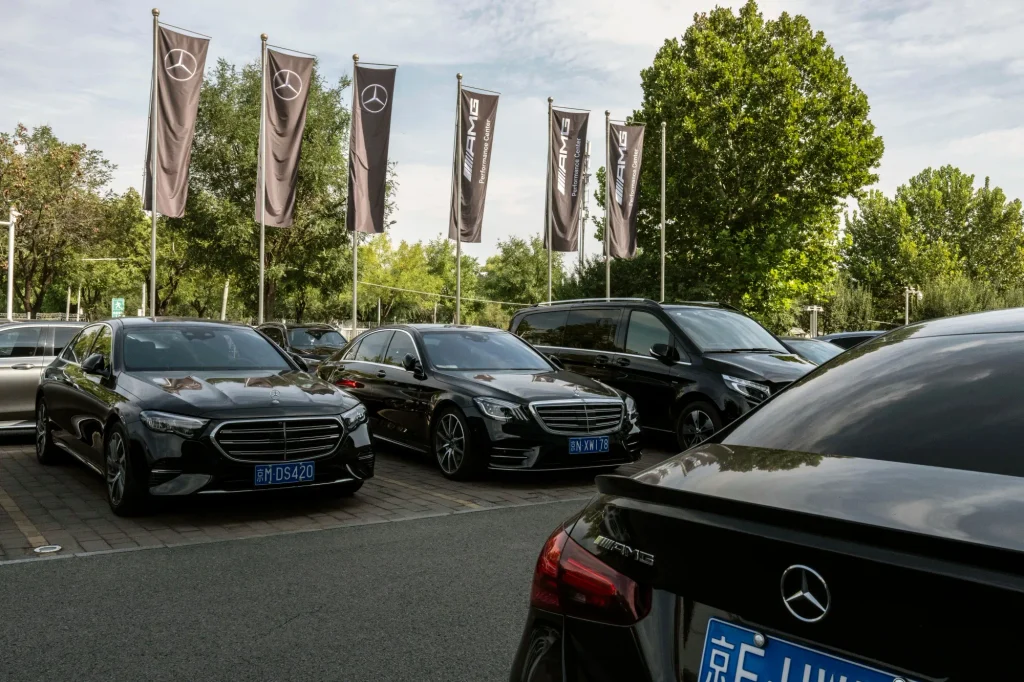
The letter, signed jointly by Representative John Moolenaar — the panel's Republican chair — and Representative Ro Khanna, its ranking Democrat, identifies six discrete disclosure categories. Mercedes-Benz North America CEO Jason Hoff was named as the requested meeting counterpart, an unusually specific personnel demand for a congressional inquiry of this type. The committee asked the company to preserve all relevant documents and electronic communications ahead of the December 1 deadline, language that mirrors litigation-hold instructions rather than routine oversight correspondence. The letter also requests details on any contacts between Mercedes-Benz personnel and Chinese government officials. Mercedes-Benz's public response, issued through its communications office on November 17, stated that "our shareholders have no management board seats and no management authority." That framing directly contests one of the committee's core concerns. For broader context on the EU trade and regulatory pressures reshaping European OEM exposure in 2026, the committee's approach is consistent with an escalating pattern of transatlantic scrutiny.
The Ownership Math Washington Is Running
Beijing Automotive Group holds approximately 9.98 percent of Mercedes-Benz Group AG. Li Shufu, Geely's chairman, holds a separate stake also cited at close to 9.98 percent. Combined, those two positions total roughly 19.96 percent — just under 20 percent of the company's outstanding shares. The Senate Commerce Committee's draft bill, approved in July, sets the prohibition threshold at 15 percent Chinese ownership. On that basis: 19.96 percent minus 15 percent leaves Mercedes-Benz approximately 5 percentage points above the cut-off before any exemption language is applied. Republican Senator Bernie Moreno has stated publicly that the final bill is expected to include a carve-out for companies such as Mercedes-Benz and Volvo Cars, but that exemption has not been written into statute as of the date this article was filed. Mercedes-Benz produced 2.04 million vehicles in 2023 according to its annual report, and the United States represented one of its three largest single-country markets by revenue.
The Exemption That Makes the Inquiry Stranger
Here is what does not add up. If Senator Moreno's promised carve-out materialises, Mercedes-Benz would almost certainly escape any sales prohibition regardless of what it discloses to the committee. So why the formal deadline, the litigation-hold language, the named-CEO meeting demand? One possibility: the committee is building an evidentiary record for a tougher version of the bill, one that may surface in a new Congress with different arithmetic. Another reading is that the inquiry is partly theatrical — pressure applied to a foreign OEM to publicly distance itself from its Chinese shareholders without Congress needing to pass anything at all. What was not confirmed in Mercedes-Benz's November 17 statement: whether Hoff has agreed to appear, whether the company will produce internal communications voluntarily, and whether any technology-transfer agreements with Chinese partners exist that go beyond the publicly disclosed Beijing Benz Automotive joint venture structure.
How This Compares to the Biden-Era Data Rule
The committee's letter targets ownership and technology access. A separate but related Biden administration rule, which took effect in early 2025, addressed a different vector entirely: driver data. That rule bars Chinese automakers from selling or manufacturing passenger vehicles in the United States on the grounds that telematics systems could funnel location and behavioural data to Beijing. The two instruments are not duplicates. The 2025 data rule applies to Chinese-domiciled manufacturers — SAIC, BYD, Chery and others — not to European OEMs with Chinese minority shareholders. Mercedes-Benz is not covered by that rule. The congressional inquiry now being directed at Mercedes-Benz represents an attempt to extend equivalent scrutiny to foreign OEMs through a different legal channel: ownership percentage rather than corporate domicile. US tariffs on Chinese-built EVs currently exceed 100 percent, a rate unchanged since the Biden administration's May 2024 tariff expansion. Mercedes-Benz does not export Chinese-assembled vehicles to the US at volume, but the committee's component-sourcing question suggests Washington wants a part-by-part accounting regardless.
What a Negative Answer Costs Mercedes-Benz
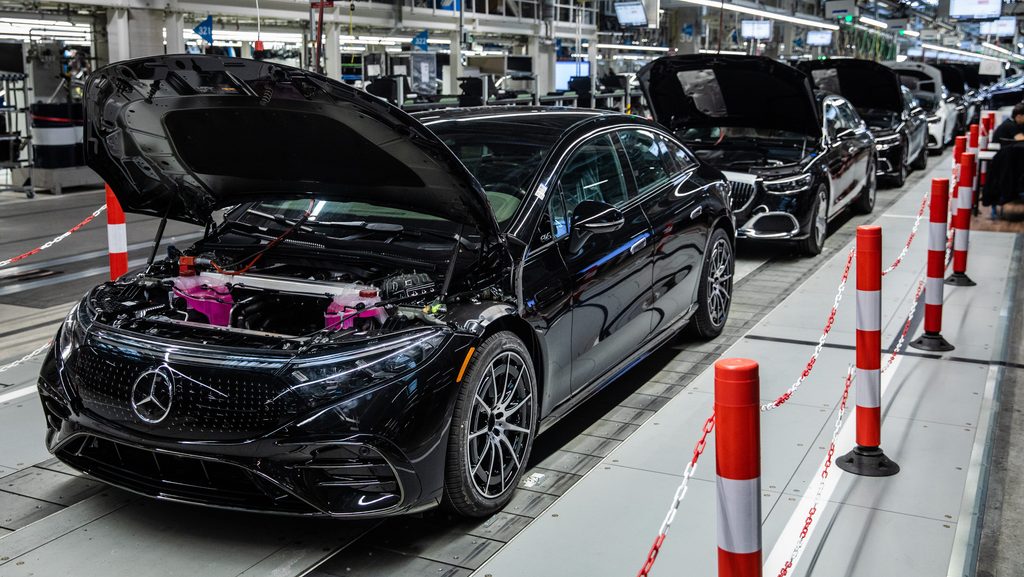
If the committee finds Mercedes-Benz's December 1 response inadequate, it has two immediate tools. First, it can recommend tightening the ownership threshold in the pending Senate bill — potentially dropping it below the Moreno exemption floor. Second, it can refer findings to the Committee on Foreign Investment in the United States, which has authority to unwind or restrict foreign ownership arrangements in companies with US operations. Either outcome carries direct cost implications for Mercedes-Benz's Tuscaloosa, Alabama plant, which employs approximately 6,500 workers and produces the GLE, GLS, and GLE Coupe for global export including back to China. A forced restructuring of the shareholder base — if regulators ever demanded one — would require Beijing Automotive Group and Li Shufu to divest combined holdings worth several billion euros at current market prices. Mercedes-Benz has not disclosed any contingency plan for such a scenario in its most recent investor communications filed with the Frankfurt Stock Exchange.
Mercedes-Benz's Beijing Benz Automotive Company joint venture, established in 1983 and now producing vehicles including the E-Class and C-Class for the Chinese domestic market, is not directly named in the committee's letter but represents the operational link lawmakers appear most concerned about. The joint venture produced over 750,000 vehicles in China in 2023. December 1 is nine days away. The complete Mercedes-Benz model history and specifications are catalogued in the Global Auto Index manufacturer database.
