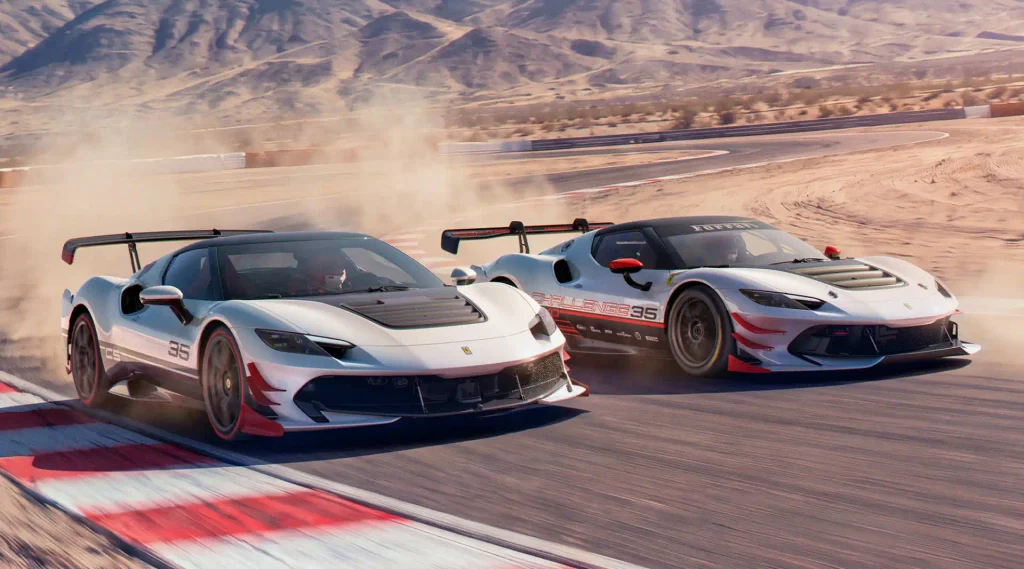
The road-legal coupé weighs exactly the same as the 296 Challenge Evo race car at 2,932 pounds dry.
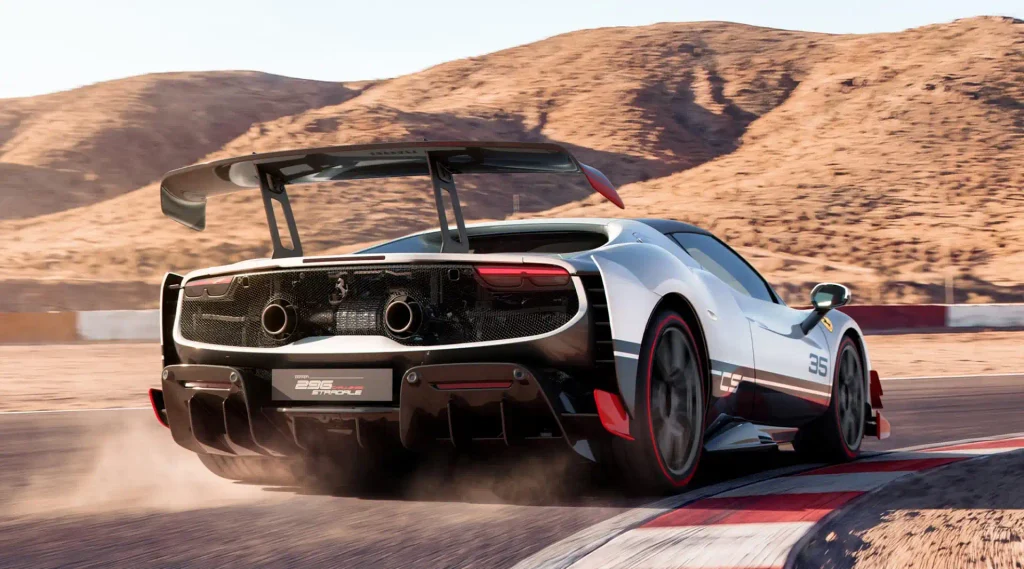
Ferrari has pulled the hybrid out entirely. The 296 Challenge Stradale — priced at roughly $307,000 — arrives with 670 hp, no electric motor, and a dry weight matching its full race sibling. Carbon doors. No armrests. One purpose.
The move is deliberate and sharp. Ferrari's own product literature, published November 2024, calls the 296 Challenge Stradale 'the production car with the closest connection to a competition vehicle' in the brand's current lineup. That is a harder claim than the 296 Speciale made when it launched — that car kept its hybrid assist. This one does not. The gap between road car and race car has never been thinner in Maranello's post-2015 era, according to Ferrari's technical documentation released alongside the reveal.
How the Hybrid Got Cut
Ferrari engineers began developing the 296 Challenge Stradale in parallel with the 296 Challenge Evo, the customer motorsport car scheduled to enter Ferrari's one-make series in 2027. Working on both cars simultaneously forced a decision early: the road car would carry no battery pack, no electric motor, and no regenerative braking. The engineering team removed the entire hybrid module, fitted a lighter transmission shaft and casing, replaced the door panels with one-piece carbon-fibre units that omit conventional armrests and storage pockets, and swapped standard seats for carbon-fibre tubular racing chairs. Those chairs are 25 percent lighter than Ferrari's own standard racing seats, according to the company's specification sheet. The result is a car that sits inside the industry-restructuring-2026 moment Ferrari has been building toward — lighter, rawer, and closer to a single-seater than any road-registered Ferrari that preceded it.
The Weight and Power Numbers That Define It
Four figures do most of the work here. Dry weight: 2,932 lb. Output: 670 hp at 8,000 rpm. Downforce at 155 mph: 1,360 lb. Fiorano lap: 1 minute 18.5 seconds. The weight saving over the standard 296 GTB is 308 lb — calculated as 3,240 lb (GTB published kerb weight, less standard options) minus 2,932 lb. That delta comes almost entirely from deleting the battery and electric motor, plus the carbon-fibre bodywork programme. Power-to-weight works out at 4.37 lb per horsepower, Ferrari confirms. For comparison, the 296 Challenge Evo produces 700 hp from the same 3.0-litre twin-turbo V6 — meaning the road car runs at 95.7 percent of the race car's output (670 ÷ 700 × 100). Gear changes in race-shifting mode take approximately 170 milliseconds. The car stops from 124 mph in 331 feet using carbon-ceramic brakes only — no regenerative assist of any kind.
Challenge Stradale vs. 296 Speciale: Two Philosophies
The 296 Speciale, Ferrari's previous track-focused variant, kept its hybrid system. That electric motor smoothed corner exits, assisted traction under hard acceleration, and gave drivers a margin of recovery mid-slide. The Challenge Stradale offers none of that. Body roll is down 68 percent versus the 296 GTB, lateral grip improves by 7 percent, and longitudinal stability rises by 34 percent — all achieved through springs roughly twice as stiff as the GTB's, supplemented by an additional spring mounted in series, a setup taken directly from the 296 Challenge Evo. The Speciale remains the more accessible machine. Ferrari's own engineers, speaking in documentation accompanying the November 2024 reveal, described the Challenge Stradale as 'fundamentally different to drive — not like the 296 Speciale, which is easier and more immediate.' That phrasing is unusually candid for a manufacturer press release. It tells serious track drivers exactly what they are buying — and implicitly warns everyone else.
What Ferrari's Specification Sheet Actually Says
Ferrari's official technical specification document, released 21 November 2024 alongside the global reveal, lists the 296 Challenge Stradale's redline at 8,500 rpm and peak torque at 546 lb-ft arriving at 6,250 rpm. Section covering powertrain development states that torque increased by more than 32 percent compared to the 296 GTB — achieved through revised boost pressure mapping, variable valve timing calibration, and upgraded thermal insulation around the turbochargers, which are carried over from the 296 Challenge race car and mounted inside the cylinder-bank V. The dual-clutch transmission is described in the same document as carrying two distinct shift programmes: an aggressive race-derived calibration active under hard use, and a smoother setting — borrowed, Ferrari states explicitly, from the SF90 XX Stradale — for lower-speed public road use. The exhaust system exits through twin tailpipes derived directly from the competition car. No production date window is given in the specification sheet beyond 'available to order now' at the $307,000 price point.
The Compliance Question Ferrari Left Open
Here is the part that does not fully resolve. Ferrari is selling a car with Pirelli P Zero Trofeo RS semi-slick tyres as a listed option, body roll reduced by 68 percent, and downforce at 1,360 lb — yet classifies it as a road-registered production vehicle in all major markets. No homologation carve-out or limited-country restriction was confirmed in documents released at launch. Ferrari has not published which specific regulatory regimes — Euro NCAP, FMVSS, or otherwise — the car was tested against, nor what noise-at-kerb figure it achieves under current EU drive-by limits. The semi-slick option is listed but its road-legality status varies by jurisdiction. Ferrari's specification sheet, November 2024, is also silent on whether the removable seat coverings — offered for the first time on any production Ferrari — have been assessed against side-impact occupant protection standards. These are not trivial gaps. At $307,000, the buyer assumes a road-legal vehicle in their home market. Ferrari has not explicitly confirmed that assumption holds everywhere the car will be sold.
Ferrari's Challenge one-make racing series, which the 296 Challenge Evo will enter from 2027, traces its road-car lineage back to the 348 in 1993 — thirty-one years and seven model generations. The Challenge Stradale is the first variant in that lineage to reach production without any form of electrified assistance. Pirelli developed both tyre specifications exclusively for this car. The complete Ferrari model history and specifications are catalogued in the Global Auto Index manufacturer database.
