65 Equity Partners takes a minority stake as Koenigsegg reports €155 million in 2025 revenue, up 80 percent since 2022.
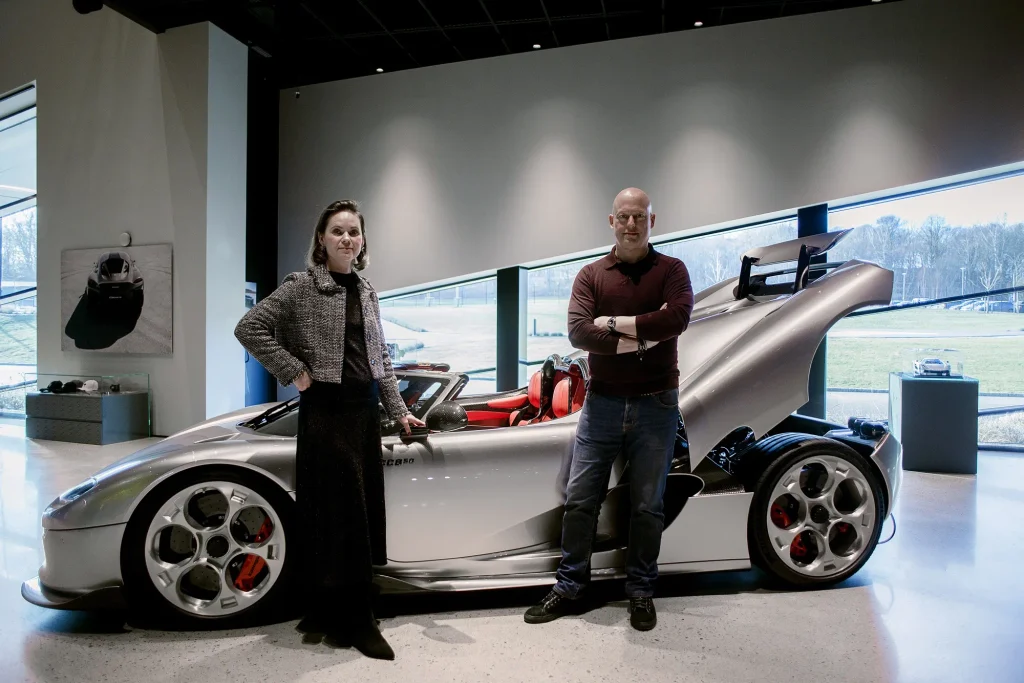
Koenigsegg is now valued at €1.3 billion. Singapore-based private equity firm 65 Equity Partners has taken a minority stake in the Swedish hypercar manufacturer, injecting €20 million. A second institutional shareholder joins Chieftain Capital Management. Christian von Koenigsegg retains majority ownership.
The deal makes 65 Equity Partners only the second institutional investor in Koenigsegg's 30-year history, according to a Koenigsegg press release published November 2025. For context: in 2024, the company sold a 6 percent stake at a valuation of roughly $1 billion. That figure has now risen 40 percent in under twelve months, a trajectory that few ultra-low-volume manufacturers have matched in the post-pandemic capital environment.
The Numbers Behind the Valuation
Start with the arithmetic. Koenigsegg reported €155 million in revenue for 2025. The company's own figures, cited in the November 2025 press release, show that figure represents growth of approximately 80 percent since 2022 — meaning 2022 revenue sat at roughly €86 million (€155m ÷ 1.80 = €86.1m). The new deal values the business at €1.3 billion, which puts the enterprise-value-to-revenue multiple at approximately 8.4x (€1,300m ÷ €155m). That is a lofty multiple for any manufacturer, let alone one employing around 800 people and building cars in Ängelholm, Sweden. 65 Equity Partners' €20 million injection represents roughly 1.5 percent of the stated valuation, suggesting the firm's stake is narrow — consistent with minority-shareholder mechanics in privately held niche manufacturers. GlobalAutoIndex's industry restructuring tracker for 2026 shows how equity structures in low-volume manufacturers have evolved across comparable deals this decade.
Von Koenigsegg on 'Entrepreneurial Spirit'
Christian von Koenigsegg, founder and CEO, addressed the deal in a statement carried in the November 2025 press release. His framing was deliberate: 'This partnership gives us additional resources to bring our ambitions to life, while preserving the entrepreneurial spirit and engineering freedom that define Koenigsegg.' The language matters. Von Koenigsegg did not describe the investment as a rescue or a growth mandate handed down by new owners. He drew a clear line between capital access and operational control. That framing was reinforced by Johan Ekdahl, Koenigsegg's chief financial officer, who told Bloomberg in November 2025 that the deal is 'not about raising cash,' characterising it instead as creating 'headroom for the future.' Ekdahl's choice of words is worth noting: a CFO who volunteers that his company does not need the money is either managing optics ahead of a possible public offering, or genuinely signalling that the business is cash-generative at current production volumes. Possibly both.
The IPO Question Nobody Has Answered
Earlier in 2025, a report alleged that Koenigsegg was considering a bid to go public. No official announcement of an initial public offering has been made. No timeline has been confirmed. No exchange has been named. That silence sits awkwardly alongside the valuation exercise this deal required. You do not arrive at a precise €1.3 billion figure without detailed financial due diligence — the kind that also happens to produce a prospectus-ready set of accounts. Ekdahl's 'headroom for the future' comment does not close the IPO door; it may leave it ajar. Chieftain Capital Management, the existing institutional shareholder that is reportedly increasing its ownership stake as part of this same round, according to Bloomberg's November 2025 reporting, also has its own return horizon to consider. Neither Koenigsegg nor Chieftain Capital Management has publicly disclosed the terms of Chieftain's increased position, including the price per share or the resulting ownership percentage.
Gemera Production and the CCGT1 Pipeline
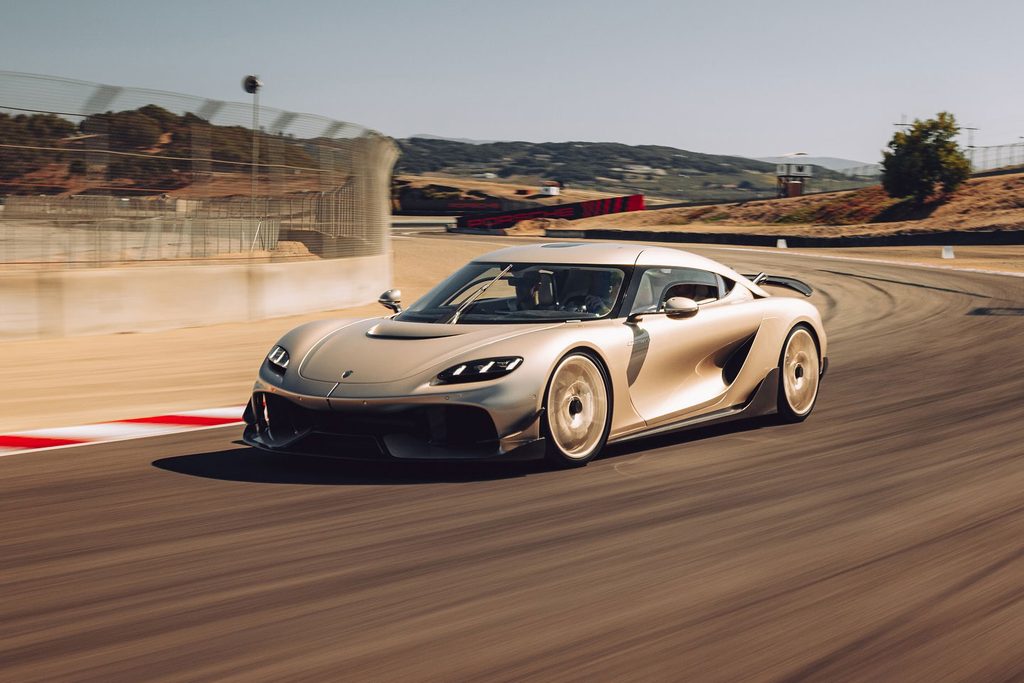
The stated use of proceeds is expansion and technology development, language drawn directly from the Koenigsegg press release, November 2025. Two products define what that means in practice. First, the Gemera: a four-passenger hypercar first shown in 2020, now in production, rated at 2,300 horsepower and 2,028 pound-feet of torque, with a planned run of 300 units. At hypercar price points, 300 units represents a production commitment that demands supply-chain investment well ahead of delivery. Second, the CCGT1, unveiled in August 2025: a road-legal race car powered by a twin-turbocharged V8 producing up to 1,600 horsepower on E85 fuel, capable of generating more than 1,323 pounds of downforce, and offered with an in-house track package — a first for the brand. Both programmes require sustained capital allocation. The 65 Equity Partners money, modest relative to the valuation, creates the buffer Ekdahl described without diluting von Koenigsegg's operational authority over either project.
How Koenigsegg's Valuation Compares
One year ago, Koenigsegg's implied valuation stood at approximately $1 billion when it sold a 6 percent stake in 2024. The current €1.3 billion figure — roughly $1.4 billion at the exchange rate stated in the November 2025 press release — represents a 40 percent uplift in under twelve months. Compare that with Pagani Automobili, which remains privately held with no disclosed institutional investors and an estimated production rate of fewer than 40 cars per year, versus Koenigsegg's current output trajectory supported by 800 employees. Bugatti, majority-owned by Rimac since 2021 following Volkswagen Group's restructuring of its hypercar holdings, operates under a different ownership model entirely — a corporate parent rather than a private equity minority stake. The Koenigsegg structure, founder-majority with two institutional minority holders, is closer to the model Ferrari used before its 2015 NYSE listing when Piero Ferrari held a fixed minority alongside institutional float. That parallel is not a prediction. It is a data point.
Koenigsegg was founded in 1994 in Vagnhärad, Sweden, and delivered its first production car, the CC8S, in 2002. The company has built fewer than 300 cars across its entire history to date. Its Ängelholm factory occupies a former Swedish Air Force hangar. Twenty-three years of production. The complete Koenigsegg model history and specifications are catalogued in the Global Auto Index manufacturer database.
