







SK Battery America cell modules with shifted electrodes are linked to more than twenty thermal incidents dating to late 2024.
Volkswagen has recalled 22,524 ID.4 crossovers in the United States. No root cause. No repair date. The company filed campaign 93EX with NHTSA in late September 2026, covering vehicles built between January 1, 2023, and February 1, 2025. Owners are told to stop charging above 80 percent. That is it, for now.
The action comes as EV battery safety draws sharpened regulatory attention on both sides of the Atlantic. Three separate Volkswagen recall campaigns now cover SK Battery America packs in the ID.4, according to NHTSA recall filings reviewed in October 2026. The two earlier campaigns — 25V836 and 26V030 — already address roughly 44,000 units from 2023 through 2025 model years. Campaign 93EX adds another 22,524. Together, that is more than 66,500 ID.4s under active fire-risk restrictions.
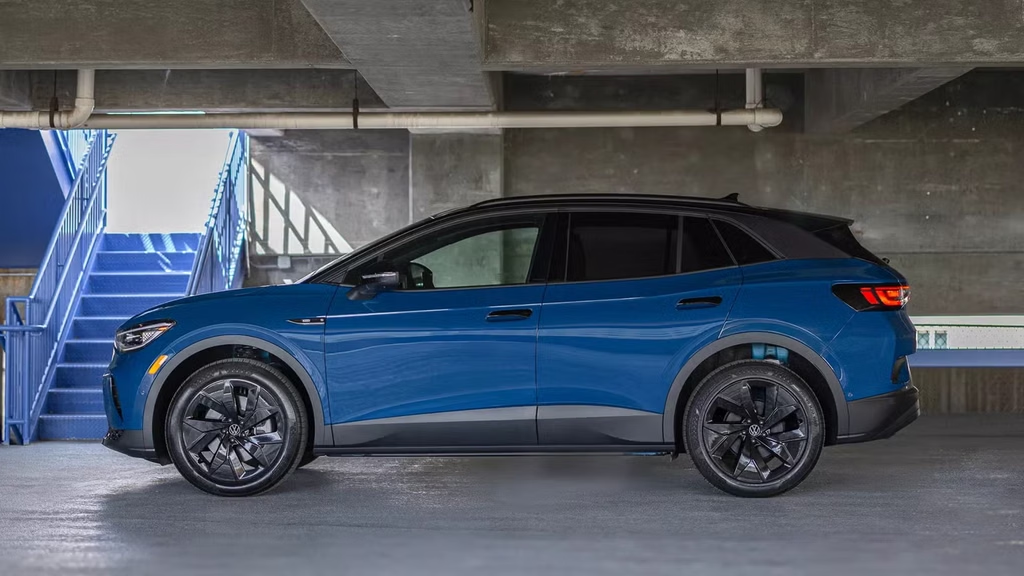
What Campaign 93EX Actually Says
NHTSA recall campaign 93EX, filed by Volkswagen Group of America in late September 2026 with a formal regulator letter dated early October 2026, identifies manufacturing defects in SK Battery America cell modules as the suspected origin of the risk. The filing describes shifted electrodes inside individual cells — a production anomaly that can generate localised overheating and trigger thermal propagation across adjacent cells. Volkswagen's Group Product Safety Committee has formally requested that SK Battery America supply detailed production-condition records and identify a so-called "clean date," the point in manufacturing after which the defect no longer appears. No clean date has been confirmed. The filing does not quantify a probability of fire per vehicle, and no parking advisory has been issued. Owners are permitted to drive the vehicles. The restriction is charging-only: stay at or below 80 percent state of charge until Volkswagen issues a second notification letter confirming an actual remedy. That second letter has no scheduled date. For broader context on how European and US regulators are aligning — or failing to align — on EV battery defect disclosure, see our coverage of EV regulation developments in Europe and North America through 2026.
Three Campaigns, One Supplier, a Running Tally
Run the numbers across all three active Volkswagen recall campaigns tied to SK Battery America packs and the exposure is larger than the 93EX headline figure suggests. Campaign 25V836 covers approximately 22,000 units. Campaign 26V030 covers approximately 22,000 more. Campaign 93EX adds 22,524. Total affected population: roughly 66,524 ID.4 crossovers under fire-risk restrictions in the United States alone — calculated as 22,000 + 22,000 + 22,524 = 66,524. More than twenty individual thermal incidents in the US are tied to these SK-built packs, according to NHTSA filings, with cases dating to late 2024. The affected production window spans twenty-five months: January 1, 2023, through February 1, 2025. Volkswagen plans to mail owner notification letters for campaign 93EX by late November or early December 2026. A second round of letters follows only when a repair exists. At the time of filing, no repair timeline had been set — meaning owners of all 66,524 vehicles face an open-ended charging restriction with no confirmed end date.
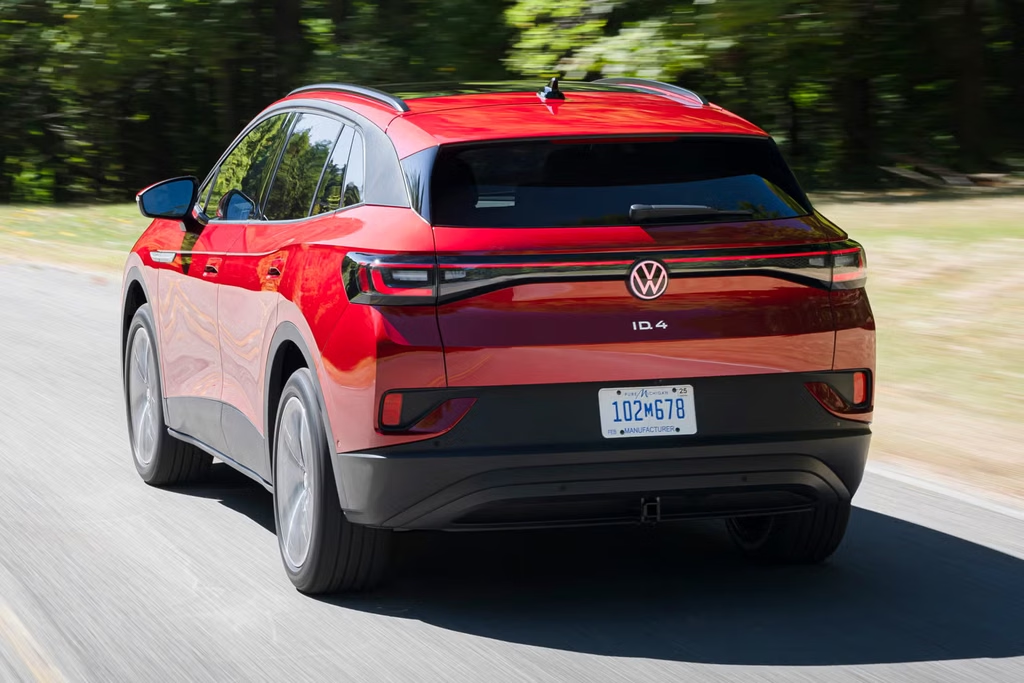
A Software Cap Where a Fix Should Be
Here is what does not add up. Volkswagen's interim response to a confirmed battery fire risk is an over-the-air software update that caps charging at 80 percent — not a repair to the battery itself. For vehicles without OTA connectivity, the mitigation is a warning sticker on the dashboard. A sticker. The company's own filing acknowledges the underlying defect is unresolved. Thermal propagation — where one cell failure cascades through adjacent cells — is not a software problem. A charge-limit cap reduces the energy state of the pack and may lower the probability of an incident, but it does not address shifted electrodes or whatever production condition created them. Volkswagen has not explained publicly why the investigation has not produced a clean date after incidents were first traced to late 2024. That is a gap of at least twenty-two months between the earliest documented incidents and the filing of campaign 93EX, with no permanent remedy in sight. NHTSA has not announced any independent investigation timeline separate from Volkswagen's own inquiry.
How This Stacks Up Against Comparable EV Battery Recalls
General Motors recalled roughly 140,000 Chevrolet Bolt EVs in August 2021 after two fires were linked to LG Energy Solution battery cells — a population more than twice the size of all three Volkswagen SK Battery America campaigns combined. GM eventually replaced battery modules on affected vehicles and negotiated a cost-sharing arrangement with LG. That process took approximately eighteen months from the first recall action to confirmed module replacements reaching owners. Hyundai's 2021 recall of 82,000 Kona Electric crossovers globally, tied to LG-supplied cells, similarly required physical battery replacement at considerable per-unit cost. Against those cases, Volkswagen's 93EX filing is unusual in one respect: neither GM nor Hyundai filed a recall while publicly stating the root cause remained unknown. Both companies had, at minimum, a working defect hypothesis before the first owner letters went out. Volkswagen's October 2026 filing is explicit that the cause is still under investigation — a posture that raises questions about whether the September 2026 filing date was driven by regulatory pressure rather than investigative readiness.
What This Means for SK Battery America and the ID.4's US Future
SK Battery America, the Georgia-based manufacturing subsidiary of South Korea's SK On, now sits at the centre of three separate Volkswagen recall actions covering a combined 66,524 vehicles. Stefan Mecha, chief executive of Volkswagen Group of America, has not issued a public statement on the recall as of the October 2026 filing date — a silence that is itself a data point. For the ID.4 specifically, the commercial timing is awkward. Volkswagen has separately confirmed the current-generation ID.4 will be replaced by a successor model, meaning the recall attaches to a vehicle already in its final sales cycle. Used-market values for ID.4 units built between January 2023 and February 2025 face downward pressure from an open-ended, unresolved defect notice. Dealers handling used examples from that production window carry disclosure obligations that vary by state. Any prospective buyer should confirm whether a specific vehicle identification number falls under campaign 93EX before completing a purchase. Volkswagen has not announced any buyback offer or loaner programme for owners during the investigation period.
Volkswagen sold approximately 29,000 ID.4 units in the United States during calendar year 2023, its strongest US sales year for the model to that point, according to Volkswagen Group of America sales reports. The 22,524 vehicles in campaign 93EX therefore represent roughly 77 percent of a single year's US ID.4 volume — built across a twenty-five-month window. Owner notification letters are due 2026. No remedy date exists. The complete Volkswagen model history and specifications are catalogued in the Global Auto Index manufacturer database.
