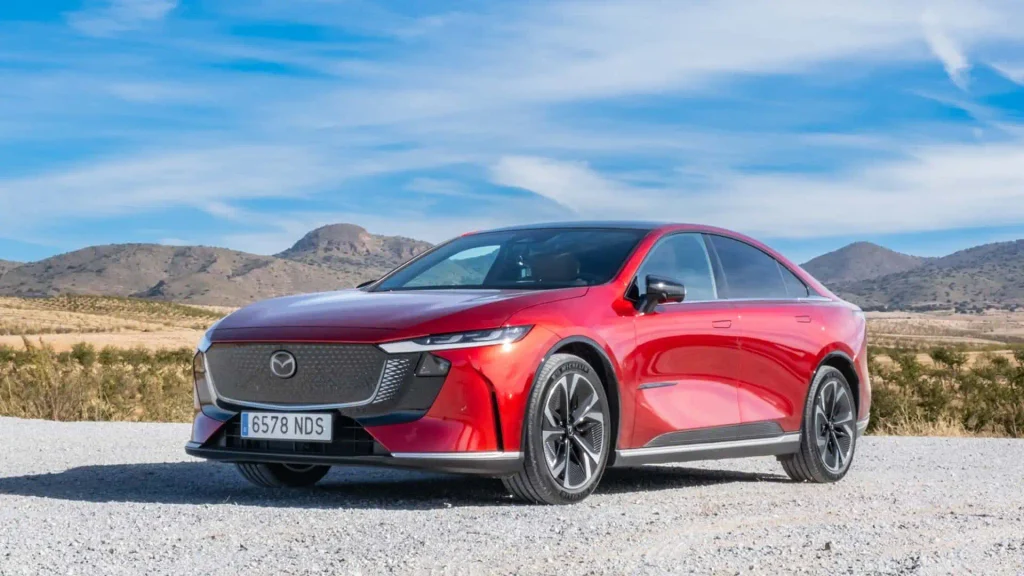
Mazda's Nanjing joint-venture plant will supply at least four electric models to export markets by 2030.
Mazda is adding models. The Japanese marque already exports the China-built 6e and CX-6e. Now it wants more. Vinesh Bhindi, Mazda Australia's managing director, told GoAuto the company has opened talks with Changan on further electric vehicles — and used one word to describe the dependence: "Absolutely."
The admission matters because Mazda's own in-house battery-electric programme has slipped to 2029, and the company is nearly halving its EV capital allocation in favour of hybrid development around the new Skyactiv-Z engine, according to Mazda's corporate roadmap statements published in 2024. Meanwhile, the EU's fleet CO₂ penalty regime — which began biting hard in 2025 — gives every Japanese OEM without a credible EV volume plan a live financial problem. Changan is, for now, Mazda's fastest answer.
From Two Models to Four: How the Changan Pipeline Fills the Gap
The 6e electric liftback and CX-6e SUV reached export markets first. Both were engineered at the Nanjing joint-venture facility, with Mazda's European ride-and-handling team overlaying suspension calibration before sign-off. Bhindi told GoAuto in late September that conversations about what comes next are already under way. Mazda's own corporate roadmap commits to two further Changan joint-venture models arriving in the 2028–2030 window, bringing the China-sourced EV count to at least four. The Nanjing plant operates as a dedicated Mazda manufacturing cell inside the broader Changan operation — not a badge-engineering line. That distinction matters to Mazda's commercial argument in markets such as Australia and the UK, where buyers have grown cautious about Chinese-origin vehicles. This is part of a wider Asian OEM China expansion pattern now reshaping how Japanese brands source electric volume outside their home market.
The Investment Arithmetic Behind Mazda's Pivot
Mazda's stated plan to cut EV capital spending by roughly 50 percent creates a straightforward arithmetic problem. The company's previous roadmap targeted 8 fully battery-electric models globally by early 2030. Removing half the internal development budget does not halve the model count target — Changan fills that gap instead. The 6e carries a UK retail price of approximately £34,995; the CX-6e lists from around £38,995. Combined, the two models represent a retail spread of £4,000 between entry EV car and entry EV SUV in the same family. If two further Changan-sourced models arrive between 2028 and 2030 at equivalent pricing, Mazda's China-origin EV revenue exposure in Europe alone could exceed £1 billion annually at modest volume assumptions: 25,000 units × £40,000 average = £1,000,000,000. That number concentrates minds on tariff risk. The EU's current 10 percent additional duty on Chinese-assembled passenger cars — separate from the provisional countervailing duties announced in 2024 — applies to Mazda's Changan output, as it does to Changan's own European ambitions.
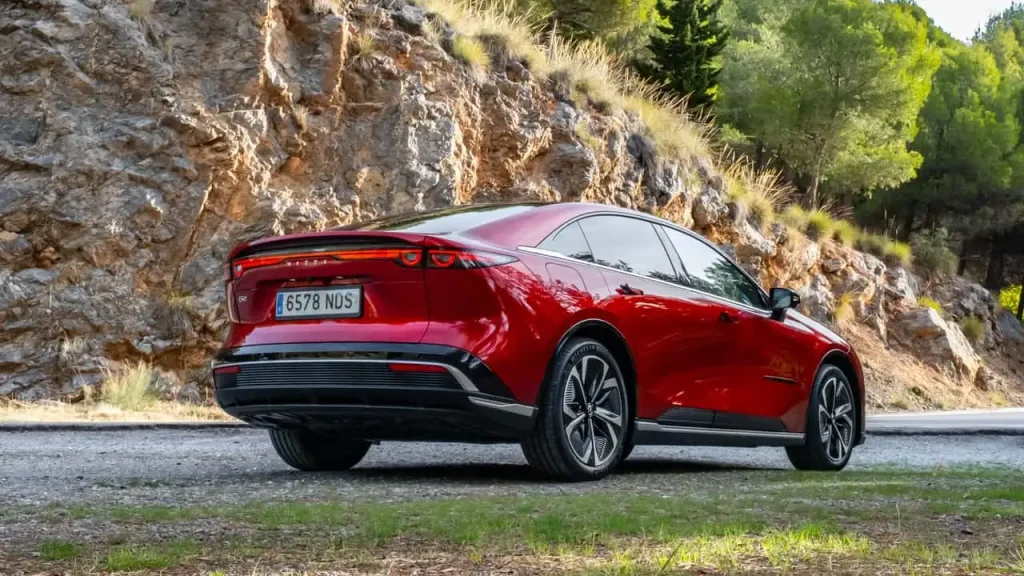
Bhindi's 'Absolutely' and What Mazda Actually Said
The most direct statement came when GoAuto asked Bhindi whether Mazda would lean on Changan for EVs while its own programme continued in the background. His published answer — "Absolutely" — is shorter than most corporate communications departments would permit. The fuller context is only marginally more hedged. On product differentiation, Bhindi said: "We've put a lot of effort in (and) we will continue to do that to make sure (Chinese-built Mazda) models are different … there are more opportunities to keep doing that." The bracketed clarifications are GoAuto's, not Mazda's. What Bhindi did not say — and what Mazda's global communications team had not confirmed as of the date of publication — is how many additional models are under active development, which segments they target, or whether any will use Mazda's own e-SKYACTIV powertrain architecture rather than Changan's platform. That is a material gap. Mazda's 2024 annual report, Section 3 (Business Overview), references the Changan joint venture but gives no model-count commitment beyond the existing two.
The Company That Preaches Multi-Solution Is Now Single-Sourcing EVs
Mazda has spent the better part of a decade defending internal combustion. Its 2023 investor briefing described a "multi-solution" approach — hydrogen, hybrid, rotary range-extender, battery-electric — as the correct answer to divergent global demand. The MX-30 was positioned as proof the company could do battery-electric on its own terms. It sold poorly across every market where it launched, and Mazda discontinued the 2.0-litre engine from the MX-5 in Europe partly because emissions credits from the MX-30's thin volume provided insufficient offset. The rotary range-extender version of the MX-30 addressed range anxiety — the original offered roughly 200 km — but arrived too late and too expensively to recover the nameplate. What does not add up: a company publicly committed to proprietary electrification that simultaneously delays its first dedicated BEV platform to 2029, halves EV investment, and signs an open-ended expansion agreement with a partner whose technology it does not fully control. The tightening of import duties across Western markets makes that dependency more exposed with each passing quarter, not less.
EU Tariff Exposure and the Regulatory Clock Mazda Cannot Stop
The European Commission's provisional countervailing duties on Chinese-built battery-electric vehicles, published in the Official Journal of the European Union in October 2024, did not name Mazda explicitly — the duties targeted Chinese OEMs and joint-venture producers whose state-subsidy exposure was assessed individually. Mazda's Changan joint venture was not among the named entities in the Commission's initial sampling. That status is not guaranteed to persist. The Commission's methodology, detailed in its anti-subsidy investigation document EU 2024/C-414, allows for reassessment of previously un-sampled producers once export volumes cross defined thresholds. If Mazda's China-origin EV volume into the EU grows from two to four models and unit sales scale accordingly, the reassessment trigger becomes a live risk. Stefan Bratzel, director of the Center of Automotive Management in Bergisch Gladbach, Germany, said in a September 2024 interview with Automobilwoche that Japanese OEMs sourcing from China face "the same tariff clock as Chinese brands — the origin of the badge does not change the origin of the car." Mazda has not published a contingency plan for EU tariff escalation on its Changan output. That silence is its own data point.
Mazda's Hiroshima parent plant produced 460,000 vehicles in fiscal year 2023, down from a pre-pandemic high above 800,000 — a capacity gap that makes China-sourced export volume structurally attractive regardless of the regulatory weather. The company's next scheduled investor update is set for November 2025. The complete Mazda model history and specifications are catalogued in the Global Auto Index manufacturer database.
