Structural bracing, retuned steering, and a panoramic roof option arrive for Japan's market only.
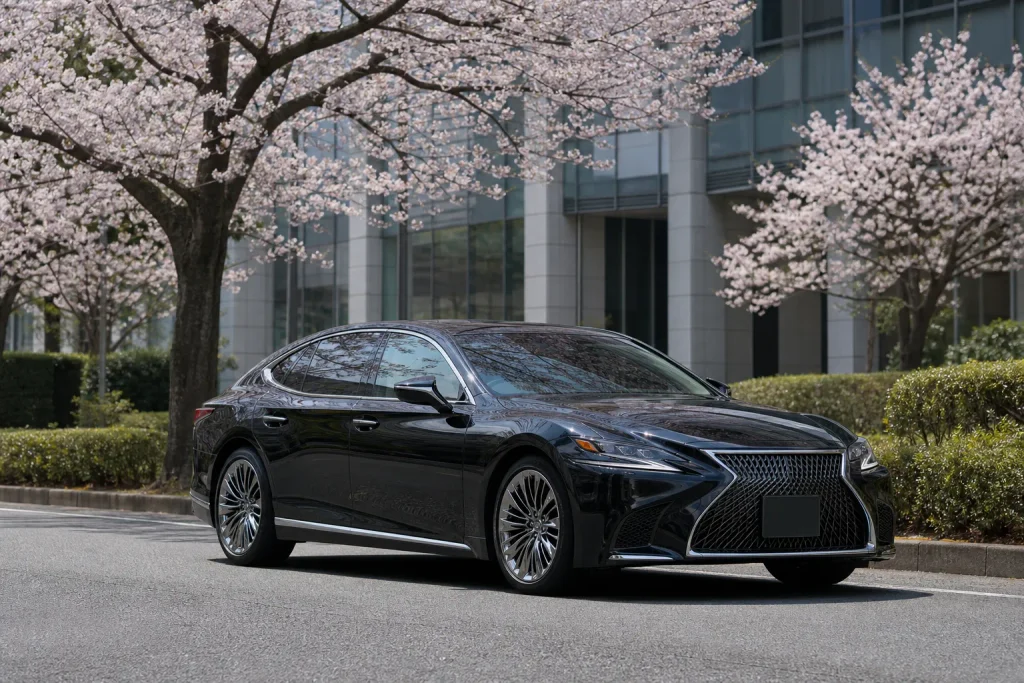
Lexus has confirmed a 2027 LS update for Japan. The fifth-generation sedan gets structural reinforcement, retuned suspension, and electric power steering recalibration. No US allocation. The American market's final LS was a 250-unit Heritage Edition, sold only for 2026.
The split reveals how differently Lexus reads its two biggest markets. Japan still supports a full-size flagship sedan priced from ¥14,140,000 to ¥18,050,000—roughly $91,700 to $117,000 at current exchange rates, according to Lexus's official Japanese model-year announcement, published September 2025. In the US, Mercedes-Benz S-Class and BMW 7 Series have each grown their sedan volumes while Lexus was withdrawing; the LS's exit leaves no direct Lexus flagship in that segment.
What Lexus Actually Changed for 2027
Engineers reinforced the LS centre tunnel and both front and rear body structures. They also added a response-enhancing damping structure to the rear suspension and luggage braces, targeting high-frequency vibration reduction at highway speeds. The electric power steering calibration was revised to sharpen on-centre weighting and produce more linear lateral response, with the stated goal of reducing body pitch and roll in cornering. A panoramic roof became available across all three trim grades—F Sport, Version L, and Executive—as a standalone option, fitted with a mesh deflector intended to cut wind noise at open-roof speeds. At the rear, the traditional 'L' badge was replaced by the full Lexus wordmark, a change the brand has applied to several recent models. The Executive grade gained cut-glass interior trim and additional leather colour combinations. These are incremental changes across a platform that entered production in 2017. Lexus has not announced any powertrain revision; the 3.5-litre V6 hybrid remains the sole offering. Coverage of comparable mid-cycle updates across recent model launches is tracked in the OEM model launches archive.
The Price Gap Between Tokyo and a Market That No Longer Exists
Japan's 2027 LS line-up opens at ¥14,140,000 for the F Sport and tops out at ¥18,050,000 for the Executive. Using a USD/JPY rate of 154 (Bank of Japan reference rate, September 2025), that converts to $91,818 and $117,208 respectively—a spread of $25,390. The US Heritage Edition LS 500, Lexus's final American offering, carried a base price of $109,450 before destination when it went on sale earlier in 2025, according to Lexus USA's press materials dated January 2025. Production was capped at 250 units nationally. At $109,450 per car, total retail revenue from that final US run reaches a ceiling of $27,362,500—assuming every car sold at base. The Japanese 2027 range, by contrast, is offered with no stated production ceiling across three grades and two drivetrain configurations: rear-wheel drive and all-wheel drive. That is at minimum six purchasable combinations before option packages are counted.
Toyota's Branding Roadmap and the LS's Uncertain Successor
Simon Humphries, Chief Branding Officer at Toyota Motor Corporation, described the intent behind two LS concept vehicles shown in 2024 as wanting Lexus to "move more freely" and "push forward as a pioneer," according to statements attributed to him in Toyota's official concept-car releases. Those concepts—a six-wheel minivan configuration and a coupe-form SUV, both carrying the LS badge—suggested the nameplate will migrate away from the traditional three-box sedan. Humphries made no reference to a direct fifth-to-sixth-generation sedan succession. Lexus has confirmed nothing about an IS replacement either, despite that model having been in production since 2013. The ES, Lexus's front-wheel-drive mid-size sedan, is the only conventional sedan in the current global line-up without a disclosed end date. Whether Lexus intends ES to absorb the volume previously served by LS in markets where the latter no longer sells has not been formally addressed.
Japan Holds While Other Markets Step Back
The LS has already been withdrawn from sale in the United States, Canada, and several European markets. In Japan, Lexus registered 1,247 LS units in the twelve months to March 2025, according to the Japan Automobile Dealers Association's fiscal-year sales summary, published April 2025—modest figures against the segment's volume peaks, but enough to justify a mid-cycle revision. By comparison, BMW's 7 Series recorded 3,891 US deliveries in calendar year 2024, per BMW Group's annual report published February 2025, and Mercedes-Benz reported 4,210 S-Class units in the same market over the same period. Lexus did not publish an LS-specific US sales figure for 2024, listing it in a combined 'other car' category. The withdrawal stands in contrast to German competitors that are accelerating electrified flagship sedan programmes: the BMW i7 accounted for 38% of 7 Series US volume in 2024, according to BMW Group's report. The BMW four-motor M3 reveal for 2027 underlines that the Munich brand is investing in performance-sedan continuity even as Lexus retreats from the segment entirely in North America.
A Refresh for a Car Without a US Future—or a Named Successor
The timing is difficult to reconcile. Lexus is committing engineering resources—chassis bracing, damper tuning, steering software recalibration—to a platform that will turn ten years old before the 2027 model year ends in Japan. No sixth-generation LS has been confirmed, announced, or teased in sedan form. The two concept vehicles Lexus displayed are neither sedans nor near-production hardware. That leaves the 2027 LS occupying an undefined position: the final generation by default, or the last bridge to something not yet publicly defined. Lexus has also not confirmed whether the IS, now in its third generation and thirteenth production year, will receive a successor. Two ageing sedans, one a farewell act in its home market, the other absent from its largest export market—while Honda navigates its own North America product gap through 2027, the Japanese luxury sedan segment is contracting without a visible recovery plan from either brand. What Lexus has not said is as telling as what it has: no replacement date, no electrified LS sedan concept, no successor timeline.
The fifth-generation LS entered production in January 2017 at Lexus's Tahara plant in Aichi Prefecture, which also assembles the LC coupe. The plant has a stated annual capacity of approximately 10,000 LS units. Trade tariff developments affecting Japanese vehicle exports to North America—documented in our analysis of the 25% US truck tariff and its ripple effects—add a further layer of cost risk to any future LS export programme. The complete Lexus model history and specifications are catalogued in the Global Auto Index manufacturer database.
