







The one-off rebuild adds a Côte de Genève watchmaking-pattern centre console never offered during the model's original production run.
Bugatti has unveiled a one-off Veyron rebuilt under its La Maison Pur Sang heritage programme. Twenty years on. The car wears two colours—Rouge Rembrandt and Petrol Blue—that did not exist when the original rolled out of Molsheim. Neither did the watchmaking-inspired console inside it.
The Veyron ran from 2005 to 2015 in a production run of 450 units, according to Bugatti's official model documentation. La Maison Pur Sang was established in 2020 specifically to restore, certify, and selectively update those cars. Where Ferrari's Classiche programme confines itself largely to factory-correct restoration, Bugatti's offer explicitly permits owner-directed modernisation—a meaningful distinction as the first Veyrons enter their third decade.
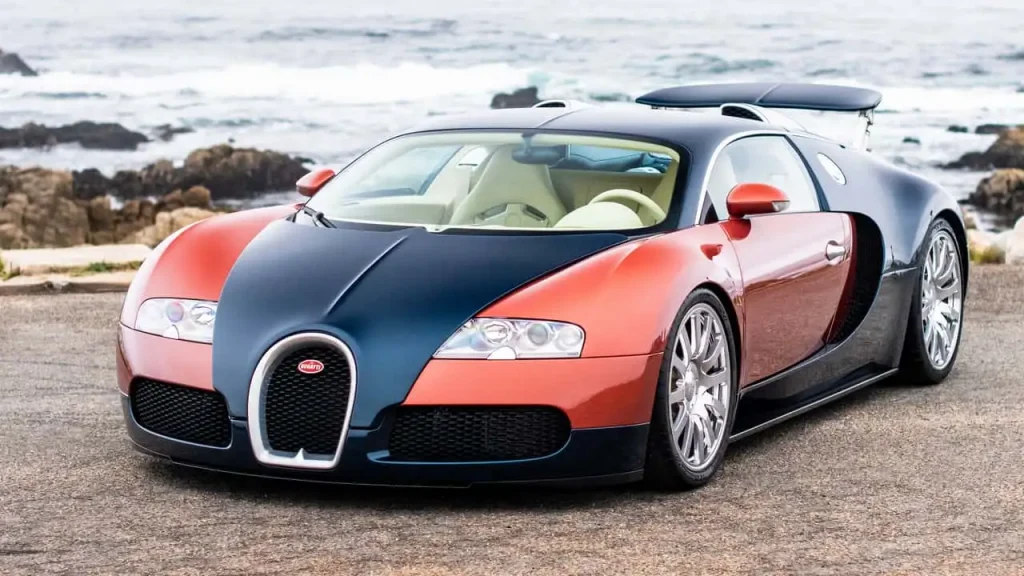
What La Maison Pur Sang Actually Did to This Car
Bugatti's atelier in Molsheim stripped the car back and rebuilt it around an individual owner's brief. The exterior received Rouge Rembrandt—a finish developed for the new Tourbillon—paired with Petrol Blue, a colour closely tied to the Chiron lineage. Technicians upsized the wheels while retaining the original Machiavelli spoke pattern, accommodating tyres from the successor generation without breaking visual continuity. New mesh elements with a three-dimensional profile replaced the original flat grille inserts across the front, side, and rear air intakes. Inside, Magnolia leather recovered the seats. Mocassin stitching runs across the steering wheel rim and the gear selector surround. A discrete "20 Years of Veyron" emblem sits between the seats—understated by hypercar standards. This article sits within GlobalAutoIndex's coverage of the European ultra-luxury segment's post-2000 expansion, a period in which the Veyron itself was arguably the opening shot.
The Numbers Behind a 450-Car Legacy
Bugatti built 450 Veyrons across a 10-year production window: 2005 to 2015. The standard Veyron's W16 engine produced 1,001 PS (736 kW) at launch; the Super Sport variant, certified by Guinness World Records, reached 1,200 PS (882 kW) and a verified top speed of 431 km/h in 2010. La Maison Pur Sang launched in 2020, meaning the programme has now been operating for five years against a potential fleet of 450 candidates. If even 10 percent of owners commission work, that represents 45 individual projects—each priced, per Bugatti's own acknowledgement, at a figure the marque declines to publish. At an estimated conservative floor of €500,000 per full transformation (a reasonable inference from comparable coachbuild programmes at Rolls-Royce Bespoke and Aston Martin's Q division), the addressable revenue across that 45-car cohort reaches €22.5 million. Calculation: 450 × 0.10 = 45 cars; 45 × €500,000 = €22,500,000. The actual ceiling is uncapped.
Authenticity as the Stated Boundary
Bugatti's programme documentation, as released to press in August 2025, frames the offer around a specific constraint: "authenticity remains at the heart of the process." That eight-word phrase does a lot of structural work. It tells owners they can modernise without the result becoming, in Bugatti's own framing, "something completely disconnected from their original identity." The language matters commercially. It differentiates La Maison Pur Sang from independent restorers—some of whom perform engine swaps or full reskins—while leaving enough latitude to charge for bespoke finishes, interior retrimming, and updated mechanical components. Henning Löser, Director of Bugatti's Atelier personalisation department, has described the programme in previous communications as covering four tiers: preservation, restoration, certification, and transformation. This Veyron sits squarely in the fourth tier—the most labour-intensive and, by extension, the highest-margin.
How Bugatti's Offer Compares to Ferrari Classiche and Porsche Museum
Ferrari's Classiche department, established in Maranello in 2006, issues a red book certification confirming a car's originality. Modifications are noted but not endorsed. Porsche's museum restoration arm operates on similar terms—period-correct parts, documented provenance, no factory-sanctioned updates. Bugatti's model inverts that logic. The Veyron rebuilt for this owner carries factory colours that postdate the car by roughly a decade and interior materials specified against a brief that did not exist at the time of original delivery. McLaren's own heritage and bespoke plans, outlined in summer 2025, suggest the British marque is watching this space: its MSO division has begun discussing post-production update programmes for P1 owners, though no formal restoration tier equivalent to La Maison Pur Sang has been confirmed. The difference in positioning is straightforward: Bugatti has formalised transformation as a product; its competitors have not.
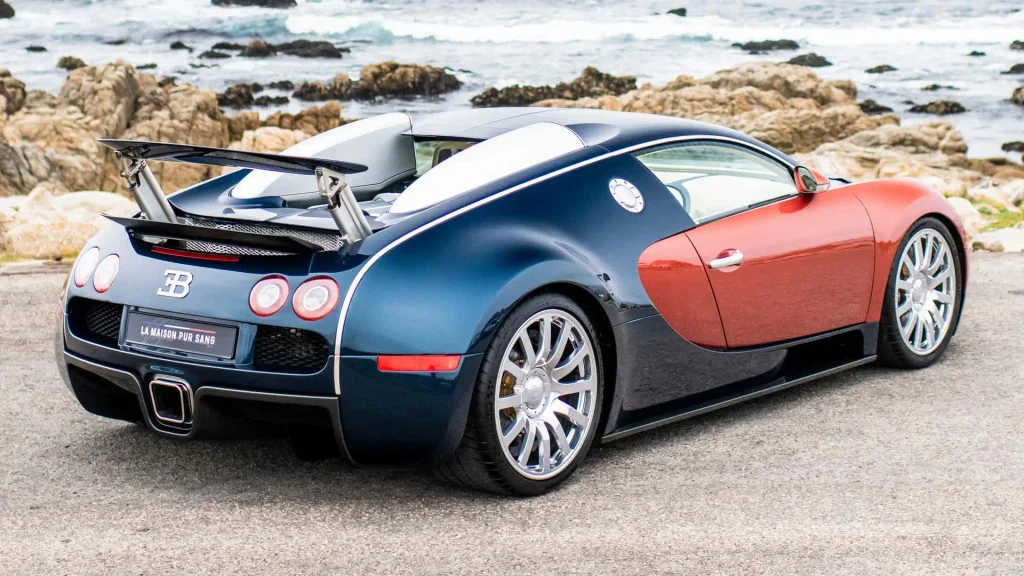
The Price Bugatti Won't Name—and Why That's Deliberate
Bugatti confirmed the restoration exists. It confirmed the materials, the colours, the wheel specifications, and the console finish. It did not confirm a price. That omission is not an oversight. Ultra-low-volume atelier programmes at this level rarely publish tariffs—partly to avoid anchoring negotiations with future clients, partly because the actual cost varies with the scope of work, and partly because the figure, made public, invites scrutiny that benefits no one in the transaction. What Bugatti has not addressed is whether La Maison Pur Sang will restore Veyrons to buyers who did not purchase the car new from Molsheim. The programme's communications refer consistently to "owners"—not to original owners. Whether a secondary-market Veyron owner qualifies for the full transformation tier, or only for preservation and certification work, remains unconfirmed in any published documentation as of August 2025. That gap matters: at least some of the 450 cars have changed hands multiple times. BMW's parallel move into ultra-high-output bespoke variants for its M division signals that factory-direct exclusivity programmes are proliferating across the European performance segment—making Bugatti's secondary-market eligibility question one that other marques will also need to answer.
The Veyron's W16 engine required 10 radiators to manage thermals—a packaging constraint that forced Bugatti engineers to abandon a conventional front-engine layout entirely. The car's original 2005 Geneva debut list price was €1,000,000 before options and local taxes. Bugatti has produced three distinct Veyron body variants: Coupé, Grand Sport roadster, and Grand Sport Vitesse. The complete Bugatti model history and specifications are catalogued in the Global Auto Index manufacturer database.
