
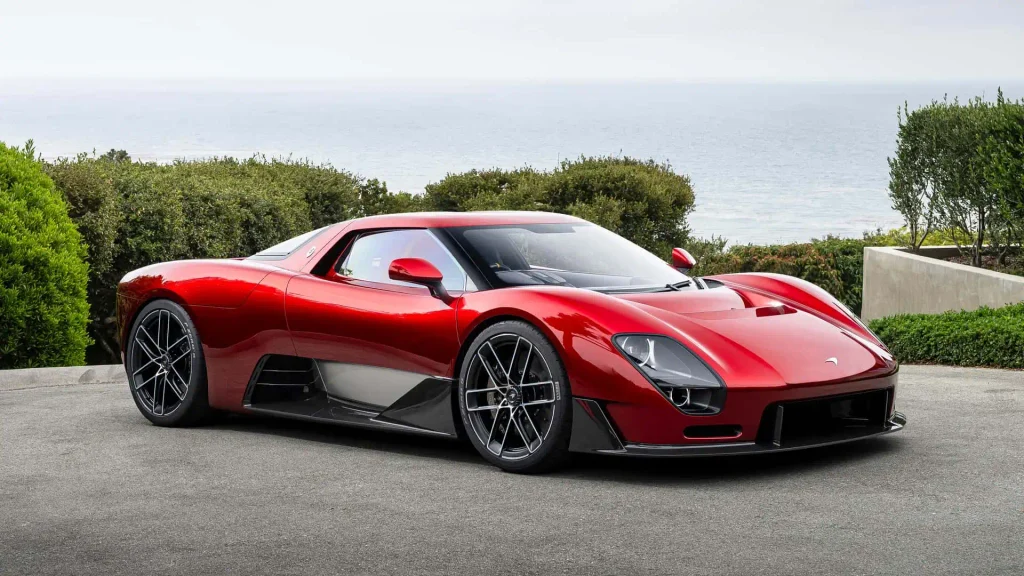

Rose-gold paint flakes, exposed shift linkage, and a $1.6 million asking price complete the package.
Spyker unveiled the C8 Preliator XXV in Monterey. Twenty-five cars. That is the entire production run. Power comes from an Audi-sourced twin-turbocharged 4.0-litre V8 rated at 789 horsepower and 739 lb-ft of torque, and the gearbox is a manual.
For context, the original C8 Preliator — shown publicly around 2016 — used the same basic Audi V8 architecture in naturally aspirated and supercharged forms producing between 525 and 620 hp. The XXV's 789 hp figure marks a step up of at least 169 hp over the prior supercharged variant, according to Spyker's published specification sheet, released August 2025. The brand has cycled through multiple ownership structures and insolvency proceedings since 2014, per the Dutch Chamber of Commerce commercial register.
Monterey Debut and the Aviation Blueprint
Spyker chose Monterey Car Week — the same calendar slot that draws Bugatti, Pagani, and the rest of the coachbuilt tier — to pull the covers off the Preliator XXV. The car arrived wearing a colour Spyker calls Quail Green, a reference to the Quail, A Motorsports Gathering event held on the Monterey Peninsula each August. Suspended in that green lacquer are rose-gold metallic flakes; all external brightwork carries the same rose-gold finish. Buyers who find that excessive can order a standard brushed-aluminium treatment instead, though Spyker's own materials suggest the rose-gold specification is the intended statement. The aviation thread runs through every exterior surface: NACA ducts appear along the flanks and hood, the five-spoke alloy wheels take their geometry from propeller blades, the rear lamps are styled as jet afterburners, and a central roof fin bridges aircraft and motorsport. Spyker has used that language since the original C8 launched in 2000, but the XXV applies it with more surface area. For a broader look at how low-volume European marques have used design spectacle to justify stratospheric pricing, see the European coachbuilt and premium segment expansion coverage on this site.
The Numbers Behind a $1.6 Million Supercar
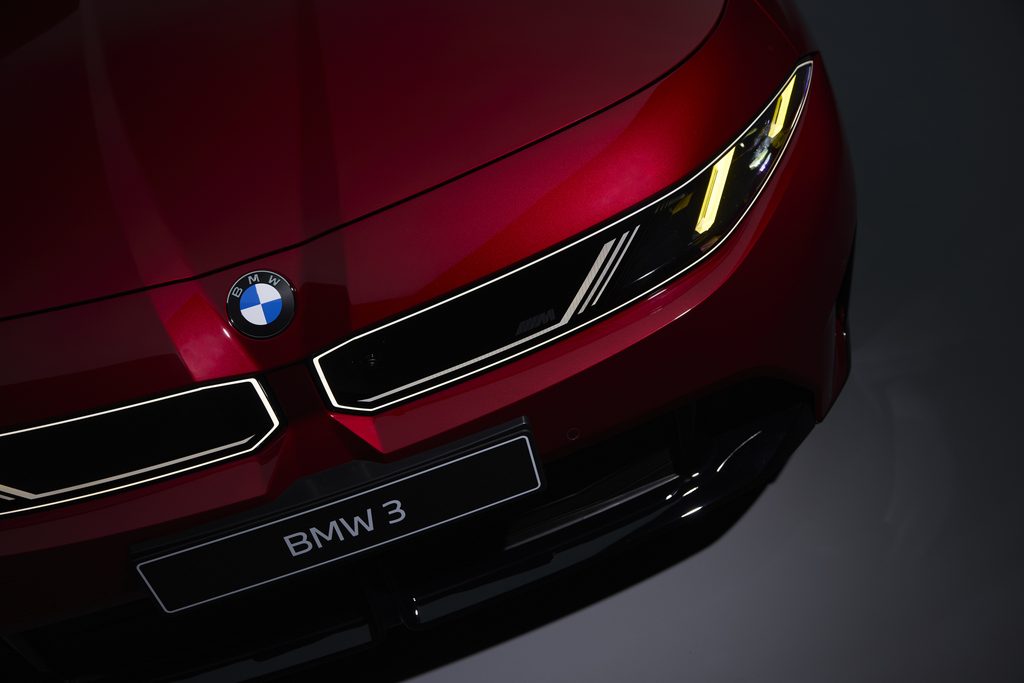
Spyker has not published an official retail price, but a figure of $1.6 million USD circulates from sources close to the order process. At that level, the arithmetic is blunt. Twenty-five units at $1.6 million each equals $40 million in gross revenue before any bespoke options — a ceiling that does not fund a GT3 racing programme or SUV development on its own. The power density is more straightforward: 789 hp from a 4.0-litre displacement works out to 197.25 hp per litre, a ratio that sits above the Lamborghini Huracán STO (around 154 hp/litre from its naturally aspirated 5.2-litre V10) and below the McLaren 750S (around 202 hp/litre from its 4.0-litre twin-turbo). Spyker claims a top speed of 217 mph (349 km/h) and a 0–60 mph time under three seconds. Torque is rated at 739 lb-ft. The BMW four-motor M3 confirmed for 2027 at 1,300 hp will roughly double the Spyker's output, though it targets an entirely different buyer profile and production scale.
What Spyker Is Actually Claiming
Spyker's own press materials describe the C8 Preliator XXV as "an all-new model," a phrase that has attracted scrutiny from people who have followed the marque. The platform lineage traces back to the aluminium spaceframe introduced with the original C8 in 2000. Victor Muller, chairman and founder of Spyker N.V., has not issued a detailed technical rebuttal to observers who characterise the XXV as a heavily revised version of the 2016 Preliator rather than a clean-sheet car. The press release, dated August 15, 2025, confirms the Audi-sourced twin-turbo 4.0-litre V8, the manual gearbox with exposed shift linkage carried over as a signature feature, and the 25-unit production cap. What the document does not specify: homologation status for European type-approval, crash-test exemption filings under EU small-series regulations, or the production facility address. Those omissions matter for any buyer expecting European road registration without additional national single-vehicle approval.
The 'All-New' Question Nobody Has Answered
Spyker's claim that the Preliator XXV is all-new sits awkwardly against the physical evidence. The greenhouse profile, the exposed shift-linkage theatre, the NACA duct placement, and the rear diffuser architecture are visually continuous with the 2016 C8 Preliator shown at Geneva that year. Coachbuilders are not prohibited from evolving an existing chassis — Pagani did it across multiple Huayra generations — but calling the result "all-new" invites the question of what, precisely, changed. No independent technical inspection has been published. Spyker did not respond to requests for a chassis designation or a bill-of-materials comparison before publication. The brand's history adds another layer of complication: Spyker filed for bankruptcy in the Netherlands in 2014 and again faced restructuring in 2016, per the Dutch Chamber of Commerce commercial register, making continuity of engineering records uncertain. Whether the XXV shares structural certification with a prior variant also affects insurance underwriting and parts availability for buyers outside the Netherlands. The McLaren product plan disclosure from summer 2025 shows how a rival low-volume manufacturer handled transparency around model succession — a contrast worth noting.
D8 SUV and GT3 Programme Hinge on These 25 Sales
Spyker has publicly stated that the Preliator XXV is the first step in a broader revival, with two follow-on projects named: the D8 Peking-to-Paris Super SUV, which was announced as far back as 2006 and never reached production, and a return to GT3-level motorsport competition. Both ambitions depend directly on whether those 25 cars find buyers at approximately $1.6 million each. Jos Barendregt, Spyker's head of communications as of the August 2025 announcement, declined to confirm how many deposits had been secured at the time of the Monterey unveiling. A GT3 homologation campaign typically costs between €5 million and €15 million depending on the series, according to the FIA's published homologation fee schedule and independent team cost estimates cited in Autosport's technical supplement, February 2024. Forty million dollars in potential Preliator XXV revenue would cover that range — but only after manufacturing costs, dealer margins, and development overheads are subtracted. The arithmetic leaves little room for error, particularly for a brand whose investor confidence has been tested repeatedly. Trade exposure is a parallel risk: new EU tariff structures discussed in coverage of the 25% U.S. truck tariff and European IVA tightening could complicate dollar-denominated pricing for European-built ultra-low-volume cars sold into North America.
Spyker's registered trade name dates to 1880, when Jacobus and Hendrik-Jan Spijker opened a coachbuilding operation in Amsterdam — a heritage the brand cites in every revival narrative. The C8 designation has been in continuous nominal use since 2000 across at least six distinct model variants. Deliveries of the XXV have not been scheduled publicly. The complete Spyker model history and specifications are catalogued in the Global Auto Index manufacturer database.
