
A single-piece BrakeNode unit cuts stopping distances 15 percent and sheds 1.5 lb per corner.
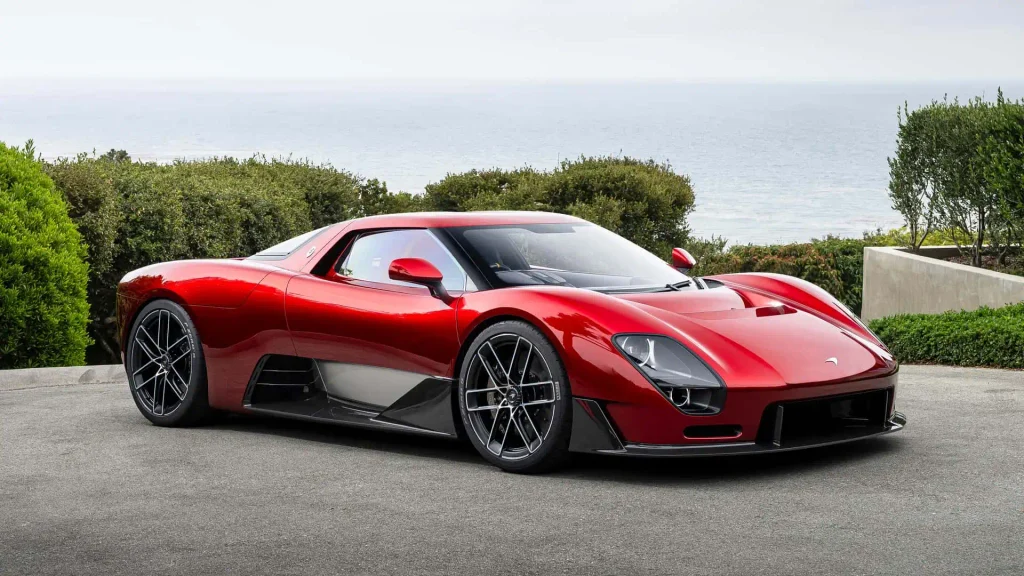
Thirty cars. That is the entire run. Czinger's 21C Spyder debuted this August at $2.75 million per copy, carrying 1,250 horsepower and a brake architecture the Los Angeles builder says no production hypercar has attempted before. The roof is gone. The downforce is not.
The 21C Spyder is the third body variant on Czinger's additively manufactured platform, following the coupe and the HDF. Where McLaren's Senna GTR and Pagani Utopia lean on conventional upright-and-caliper assemblies, Czinger's BrakeNode merges those elements into a single printed structure — a consolidation approach documented in Czinger's technical release, published August 2025. The wider European performance hypercar segment has been edging toward integrated corner modules since roughly 2018; Czinger is the first volume claimant to ship one.
The BrakeNode Numbers, Corner by Corner
Czinger's BrakeNode merges the suspension upright, brake caliper, and hydraulic fluid channels into one component. Four corners means four units, each saving 1.5 lb of unsprung mass — 4 × 1.5 lb = 6.0 lb total removed from unsprung weight across the car. That is not trivial on a vehicle that already sits at competition weight. Front rotors measure 16.1 inches in diameter; rears are 15.3 inches, clamped by calipers fitted with titanium pistons rather than stainless steel. Czinger's own technical release, published August 2025, states the titanium specification keeps hydraulic fluid 15 percent cooler under sustained braking. The company further claims a 15 percent reduction in stopping distances versus conventional setups. Taken together — 6.0 lb less unsprung mass, 15 percent cooler fluid, 15 percent shorter stops — the BrakeNode is doing three jobs a conventional assembly hands to separate suppliers. Whether independent testing confirms the stopping-distance figure is, at this writing, unverified.
Serviceability Claims That Cut Against Hypercar Convention
Hypercar brakes are, almost universally, a two-person, half-day job. Czinger says BrakeNode flips that. Pad replacement requires no caliper disconnection — the technician reaches through the top of the structure. Rotors, according to Czinger's August 2025 product brief, 'can be tilted out from the side.' A drain plug sits at the base of the unit for hydraulic fluid changes. None of that maps to how exotic brake systems normally work, and Czinger has not published third-party service time data to support the claim. What is also absent from Czinger's release: any statement about pad compound certification for road versus track use, or rotor replacement cost. The 21C Spyder's 30 owners will presumably never need a quick pit-lane swap, but the claim of superior serviceability without supporting labour benchmarks is a gap worth watching. No independent brake engineer contacted for this article had yet examined a production BrakeNode unit.
Downforce Without a Roof
Czinger's August 2025 technical release describes the open-top aerodynamics package with a precision that most builders reserve for closed-class race entries: the 21C Spyder 'generates 3,267 pounds of downforce at 150 mph' without its roof panel in place. Fit the roof and that rises to 3,307 lb — matching the HDF variant's figure. The document notes that 'nearly 60 percent of the pressure is rear-biased,' a deliberate distribution to stabilise the car at high speed with no fixed roof structure to anchor the aerodynamic load path. A 76-inch swan-neck rear wing and a full-length underbody diffuser — wrapped around the rear subframe and gearbox — generate the bulk of that load. For context, McLaren's current track-focused models operate in roughly the 1,200–1,800 lb downforce window at comparable speeds. Czinger is not in that window. It is somewhere else entirely.
Same Powertrain, Different Problem Set
The 21C Spyder carries the identical hybrid drivetrain as the 21C HDF: a twin-turbocharged 2.88-litre V8 paired with two front-axle electric motors and a rear-axle motor-generator, combined output 1,250 hp and 691 lb-ft of torque routed through a seven-speed single-clutch transaxle. Czinger quotes 0–60 mph in 1.9 seconds and a quarter-mile in 8.7 seconds — a faster quarter-mile than the Bugatti Chiron Super Sport's published 9.4-second figure, though the Chiron weighs roughly 1,000 lb more and was never designed around an additive-manufacturing production process. Top speed is 205 mph. The Spyder's engineering challenge was not the powertrain — that was already proven — but keeping aerodynamic and thermal behaviour predictable once the fixed roof was removed. On that front, the 40 lb of downforce lost without the roof panel is surprisingly small, suggesting the floor and wing carry most of the work regardless. Brake system integrity under regulatory scrutiny is a live issue across the performance segment; Czinger's integrated architecture may face different certification questions than traditional assemblies in certain markets.
Thirty Buyers, One Production Facility, Open Calendar
All 30 Spyder examples will be hand-built at Czinger's Los Angeles facility. At $2.75 million starting price before personalisation, the total potential revenue across the run is $2.75 m × 30 = $82.5 million — before options, which on cars at this price point routinely add 15–30 percent per unit. Kevin Czinger, founder and chief executive of Czinger Vehicles, has not publicly confirmed a delivery start date as of the August 2025 release; the company's statement describes the car as available for order, not as delivered. That distinction matters to the 21C platform's existing customers. The Spyder is also the first open variant, meaning buyers are being asked to commit to a configuration — and a brake system — that has no road mileage record yet. The BrakeNode is additively manufactured; its fatigue behaviour across tens of thousands of braking cycles under track conditions is not covered in public documentation. For a segment watching power outputs climb past 1,300 hp, durability data on printed brake structures will become the next credibility test.
The 21C platform first appeared publicly at the 2021 Pebble Beach Concours d'Elegance, when Czinger showed the original coupe with a then-quoted price of $1.7 million — $1.05 million below the Spyder's current opening figure. Three variants across four years. Thirty open-top cars are all that will ever exist. The complete Czinger model history and specifications are catalogued in the Global Auto Index manufacturer database.
