







Transit City electric van and Ranger Super Duty join five passenger vehicles targeting growth recovery.
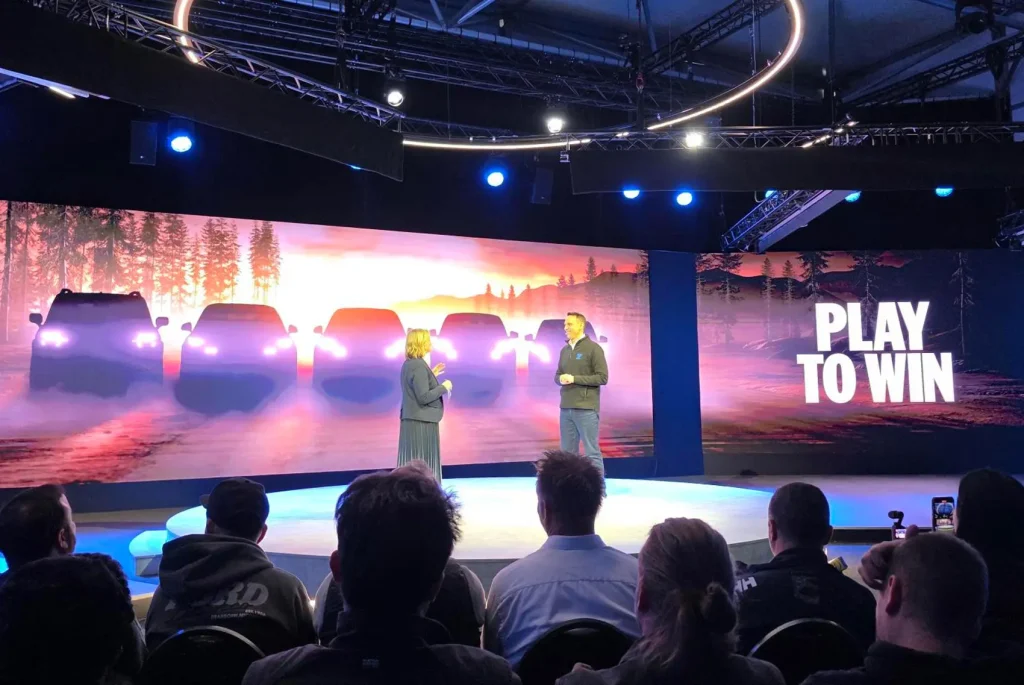
Ford will launch seven new vehicles across Europe by 2029. The plan includes five passenger models with rally-inspired styling. Commercial vehicles get two immediate additions. Growth targets replace market defense.
The offensive marks Ford's most ambitious European product push since its 2019 restructuring, when it cut passenger car production and focused on commercial vehicles. Ford Pro has dominated European commercial sales for 11 consecutive years, according to company presentations delivered at the Salzburg dealer meeting in May 2024.
Software Revenue Targets 25% of Ford Pro Profits
Ford Pro targets software and services generating 25 percent of EBIT by 2029. First quarter 2026 showed paid subscriptions jumping 30 percent to 879,000 globally. Gross margins exceeded 50 percent. The division connects 1.2 million European customers generating 6 million diagnostic signals daily. In 2024, the system delivered 997,000 additional uptime days—a calculation based on prevented breakdowns multiplied by average repair duration. Early dealer pilots cut repair times 50 percent while identifying 80 percent of issues before failure. Ford's broader European strategy positions software as the primary profit driver beyond traditional vehicle sales.
Ranger Super Duty Targets 8-Tonne Operations
The Ranger Super Duty specification sheet details a combined gross weight rating of 17,637 pounds—equivalent to 8 metric tonnes. Towing capacity reaches 9,921 pounds or 4.5 metric tonnes. Payload hits 4,409 pounds, approximately 2 metric tonnes. Ford designed the vehicle for emergency services, forestry, mining and military applications requiring maximum durability. Standard equipment includes reinforced suspension, underbody protection and increased ground clearance compared to standard Ranger models. The specification targets operators requiring capabilities beyond typical pickup truck limits, competing directly with specialized commercial chassis.
Transit City Reverses Traditional Van Strategy
Transit City arrives as a single high-specification electric van, contrasting Ford's traditional multiple-trim approach. Chinese manufacturers pursuing European production typically launch with broad model ranges, while Ford narrows focus to urban fleet buyers. The van targets low-emission zones spreading across European cities—restrictions absent when Ford launched the original Transit in 1965. Three variants include chassis cab configurations for custom upfitting. Dealership availability begins end-2026, timing Ford's entry against established electric van competitors already holding market positions. The strategy prioritizes specification depth over choice breadth.

Rally Heritage Drives Passenger Design Direction
Ford's passenger vehicle announcement emphasized "styling influenced by the brand's rally heritage and more than a century of competition history." The commitment covers five models launching through 2029, all built in Europe. A Bronco family member targets European buyers specifically. Valencia plant production begins 2028 with a compact multi-energy SUV. Two additional models include a B-segment electric car "tuned for sporty driving dynamics" and a small urban electric SUV sharing design language. Two multi-energy crossovers complete the range by 2029. Performance positioning reflects broader industry trends toward sport-influenced styling across mainstream segments.
Regulatory Stance Contradicts Electrification Push
Ford simultaneously announced zero-emissions commitment while criticizing European regulatory targets as misaligned with consumer demand. The company argues fast-moving targets slow fleet turnover with "counterproductive effects on overall emissions." Ford requests greater openness to plug-in hybrids and extended-range electric vehicles—technologies competitors are abandoning for pure battery power. The position creates tension: Ford develops new electric models while publicly questioning the timeline driving their development. Small business protections receive specific mention, citing inadequate charging infrastructure and electrical grid connection delays. This regulatory critique accompanied product announcements emphasizing electrification capabilities.
Ford Pro's predictive connectivity covers every commercial vehicle sold since 2019, with embedded modems standard across the range. The dealer meeting occurred in Salzburg during May 2024, marking the first major European product announcement since 2022. Ford's European passenger car production ceased in 2019 before this revival plan. The complete Ford model history and specifications are catalogued in the Global Auto Index manufacturer database.
