



Track-only derivative weighs under 1,000kg while race version must hit 1,030kg minimum
McLaren's MCL-HY GTR abandons hybrid power for pure V6 thrust. The track-only machine delivers 720hp from a twin-turbocharged 2.9-litre unit. Weight drops below 1,000kg. Customer deliveries start late 2025.
The move reflects McLaren's commitment to naturally aspirated alternatives as European manufacturers navigate electrification pressures. While the race-spec MCL-HY hypercar produces 697hp with hybrid assistance, the GTR exceeds this figure through weight reduction and regulatory freedom, according to McLaren's technical specifications published May 2024.
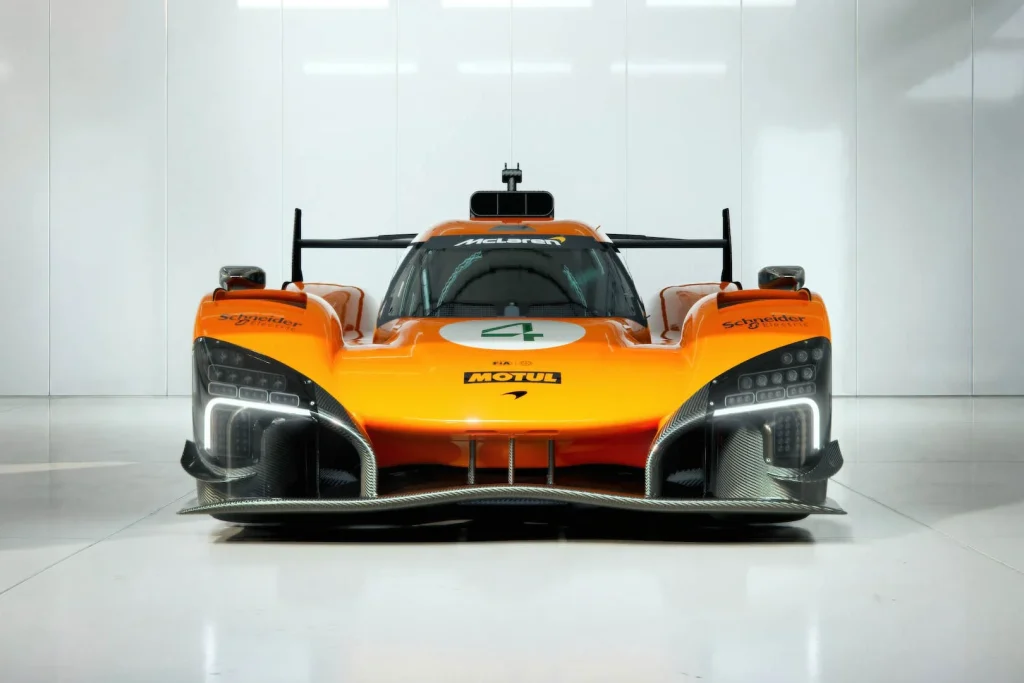
Power gains through subtraction
The GTR's approach contradicts industry hybrid adoption trends. Where BMW pushes 1,300hp through four motors, McLaren subtracts the Motor Generator Unit entirely. The race car must weigh 2,270 pounds minimum under LMDh regulations. The GTR faces no such restriction. Engineers calculate the MGU removal saves approximately 70kg from the carbon-fiber monocoque. Combined with other weight reductions, the GTR dips below the psychologically important 1,000kg threshold. Ferrari's 499P Modificata retains its front electric motor despite customer track focus. McLaren's philosophy differs completely.
Track program mathematics
McLaren packages the GTR with a two-year driving program spanning six international circuits. The calculation: 12 events total across 24 months equals one track session every other month. Each event includes pit crew support and professional coaching. The W1 road car starts at $2.1 million before options. Industry observers estimate the GTR commands a 40-50% premium, placing it around $3 million. Six events over two years breaks down to $500,000 per track day excluding the car itself. Porsche's similar Sonderwunsch program charges $200,000 annually for comparable services. McLaren's premium reflects the car's race-derived pedigree and exclusive VIP client access.
Concurrent development breaks tradition
McLaren describes the project as a "first-of-its-kind collaboration" between racing and automotive divisions in technical documents released this month. Traditionally, customer track cars follow race versions by 18-24 months. The GTR developed alongside the FIA hypercar from project inception. Both share identical carbon-fiber monocoque architecture. Track testing of the race specification begins this month ahead of the 2027 WEC debut. The parallel development timeline compressed normal engineering phases. Racing division input influenced customer car aerodynamics and suspension geometry from day one rather than reverse-engineering solutions.

Road conversion questions persist
McLaren refuses to discuss road-legal conversion possibilities despite customer inquiries. The company maintains strict track-only positioning for the GTR. However, specialists like Lanzante previously converted race cars for road use. The GTR's lack of hybrid assistance actually simplifies potential homologation compared to complex energy recovery systems. Manufacturing capacity constraints may limit McLaren's willingness to pursue road variants. VIP client agreements reportedly include clauses preventing unauthorized modifications. Yet no technical barriers prevent road conversion beyond lighting, mirrors, and emissions compliance. The contradiction between customer demand and company policy remains unresolved.
Testing begins this month at undisclosed European circuits, with the first customer cars scheduled for Silverstone delivery in December 2025. McLaren plans 75 GTR units maximum. Production ends when race program concludes. The complete McLaren model history and specifications are catalogued in the Global Auto Index manufacturer database.
