

Nissan has issued the following press release:
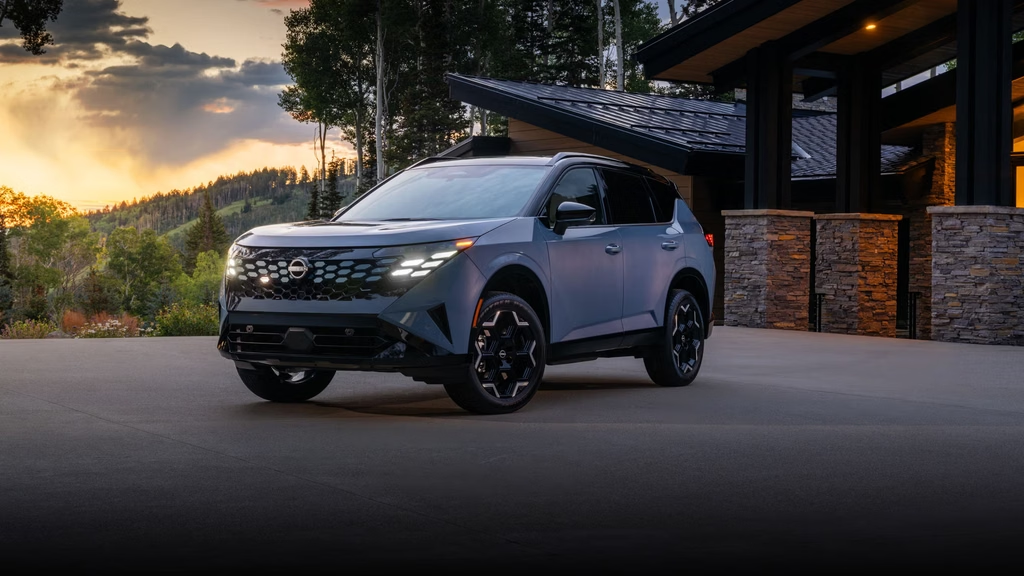
Being given its public debut at the 2007 Geneva Motor Show, the new X-TRAIL goes on sale across Europe in the summer. Such was the success of its predecessor that the new model will be available in Europe before sales start in Japan’ the first time in Nissan’s history that this has happened for a model built in Japan.
It offers more interior space than before, greater comfort and refinement, more equipment and, thanks to three new engine options, better performance, economy and reduced emissions. Passenger and pedestrian safety has been enhanced while the new X-TRAIL has more practical and user-friendly features.
New from the ground up, the latest X-TRAIL shares the same platform as the recently launched Nissan Qashqai. The platform features strut-type suspension at the front with a multi-link system at the rear, both ends being mounted on separate rubber insulated sub-frames providing enhanced refinement and isolation from vibrations.
As a result, new X-TRAIL is slightly larger than before: its wheelbase has increased by 5mm to 2630mm, while overall length has risen by 175mm to 4630mm. Much of this extra length can be found in the trunk area, which has increased dramatically in size.
The approach and departure angles of 28 and 23 degrees respectively and a generous 200mm ground clearance enable the X-TRAIL to traverse difficult terrain with comparative ease. It can safely stake its place in Nissan’s 4×4 range alongside such iconic vehicles as Patrol and its big brother, the Pathfinder.
Next generation ALL MODE
At the heart of X-TRAIL’s 4×4 armoury is the latest ‘intelligent’ version of Nissan’s highly regarded ALL MODE electronic all-wheel drive system. In addition, X-TRAIL boasts a range of petrol and diesel engines all developing strong levels of torque making them perfectly suited to the low speed controllability needed off-road.
A simple to operate system, ALL MODE 4×4-i has a rotary knob on the centre console offering a choice between two-wheel drive or Auto mode. — Volkswagen Tiguan's acceptance drive in Namibia.
Lock operates at speeds of up to 40km/h and is automatically over-ridden each time the engine is re-started.
Among the other highlights of ALL MODE 4×4-i are DDS and USS, standing for Downhill Drive Support and Uphill Start Support. USS is a fully automatic system that activates on any slope that exceeds a 10 per cent incline, holding the vehicle on the brakes until the driver starts to move away. The system also works if the vehicle is reversing up an incline.
DDS – operated via a switch on the centre console – operates when ALL MODE is in lock mode. DDS uses the anti-lock brakes to maintain a descent speed of 7km/h. allowing the driver to concentrate on steering. Like USS, DDS also works when the vehicle is in reverse.
Three new engines
New X-TRAIL has a wider range of engines than its predecessor, with two petrol and two diesel options being offered: only one engine – a 2.5-litre 16 valve four-cylinder petrol unit – has been carried over, albeit with further improvements, from the original model. The other three engines are all new.
For the first time, X-TRAIL offers two levels of turbo-diesel power. The engines are versions of the highly regarded 2.0-litre M1D unit developed by Alliance partner Renault which combines high outputs and good economy with class-leading refinement.
In X-TRAIL, power outputs are 110kW (150hp), which increases to 127kW (173hp) when the engine is intercooled. Torque outputs are 320Nm and 360Nm respectively, 90 per cent of which is developed, in both cases, at a low 1750rpm.
Both engines are fitted with diesel particulate filters to minimise emissions. — Jeep's first four-door Wrangler.
Standard on both versions is a six-speed manual transmission, though the 110kW model is optionally available with a new six-speed automatic. It’s the first time a diesel X-TRAIL has been available in automatic form and gives the model a further edge over rivals.
The new petrol engine, is a lightweight all-alloy 16 valve 2.0-litre producing 103kW (140hp) and 193Nm of torque. Development was led by Nissan and it will be used within the Renault Nissan Alliance. Unusually for a petrol engine, much of the torque is developed low down the rev band – 90 per cent is available from 2400rpm.
Although carried over from the original, the 2.5-litre 124kW (169hp) petrol engine has been further improved for greater refinement, better efficiency and extended service intervals. Providing best-in-class low- to mid-range torque figures – peak torque is 233Nm – the engine has proven extremely popular for towing. Both petrol versions have six speed manual gearboxes as standard, with CVT transmission optionally available.
All new evolutionary design
Although X-TRAIL has been completely restyled, customer research clearly showed that the robust, strong shape was popular and well appreciated. Indeed, it was a key factor in the decision making process for many buyers. It was clear that the
“X-TRAILness” had to be retained, which is why there is a clear family resemblance between the original and the new version. Key design cues, such as the solid shoulder line, deep glasshouse and static window line, have been transferred to the newcomer. The squared off appearance gives practical benefits too – with maximised interior space and the feeling of reassurance which is important to many buyers.
Strength is conveyed by the deep D-pillar behind the revised profile of the rearmost side window, by the extended wheel-arches and by the tough grille, which echoes the style found across Nissan’s 4×4 range.
At the back, the one-piece top-hinged tailgate extends deep into the bumper to create a low loading sill, while the high mounted stop lamp has been integrated into the top of the frame itself, rather than being mounted behind the tailgate glass as before. — 2005 Geneva International Motor Show.
Premium interior
The interior continues Nissan’s practice of providing much higher levels of quality and premiumness than expected for the class of car. Soft feel materials feature on all touch points, while grained plastics and flocked surfaces in contrasting shades – black and grey or black and sand – are used throughout the cockpit. Depending on the trim level, instrument surrounds and other features are finished in silver or titanium colours to give a technical feel.
And as with other recent Nissan models, X-TRAIL has been created with versatility and practicality uppermost. Positioning the instrument cluster behind the multi-function steering wheel has allowed greater versatility in the centre console, which can now house a larger navigation screen closer to eye level as well as providing space for an in-dash multi disc CD changer.
A large centrally-mounted dash-top storage box is now deep enough to house a full size tissue box or no fewer than 10 CD jewel cases while a vast 15.7-litre glove box has a dedicated section for the owner’s manual.
Larger, more flexible trunk
Perhaps the most versatile aspect of the new X-TRAIL is the trunk, however. With the rear seat in place, the original vehicle had a VDA measurement of 410-litres up to the lower edge of the rear window: in the new X-TRAIL the equivalent figure is
603-litres, an increase of 193-litres.
This has been achieved by rerouting the exhaust silencer from its original transverse position under the boot floor to a north/south location alongside the rear wheel well. This has allowed the creation of an innovative double deck trunk, with space for a sliding drawer under the floor where valuable items can be stored away from prying eyes.
As before, the rear seat backrests recline through 7 degrees for maximum passenger comfort, and also fold flat to increase load space. But rather than a conventional 60/40 split fold, the new X-TRAIL has 40/20/40 folding system, again to increase flexibility.
