


Time magazine's 2026 Best Inventions Design nod arrived as Topolino orders climbed 30% year-on-year in Q2.
Fiat says the Topolino became Europe's electric quadricycle segment leader in 2025. Twenty percent share. Orders up 30 percent in Q2 year-on-year. Then Time added a Design award on top. Small cars rarely collect both commercial traction and editorial recognition at once.
The quadricycle category sat largely ignored for years — dominated -volume French microcars and light-mobility curiosities. Fiat's revival of the Topolino nameplate changed that calculus, according to Stellantis's commercial briefing published October 2026. For context, the broader European electric passenger-car market grew roughly 14% in the same period, per the European Automobile Manufacturers' Association (ACEA) monthly registration report, October 2026 — making the Topolino's 30% order climb a different order of magnitude.
Time's Design Category Picked a Car That Ignores Range Anxiety
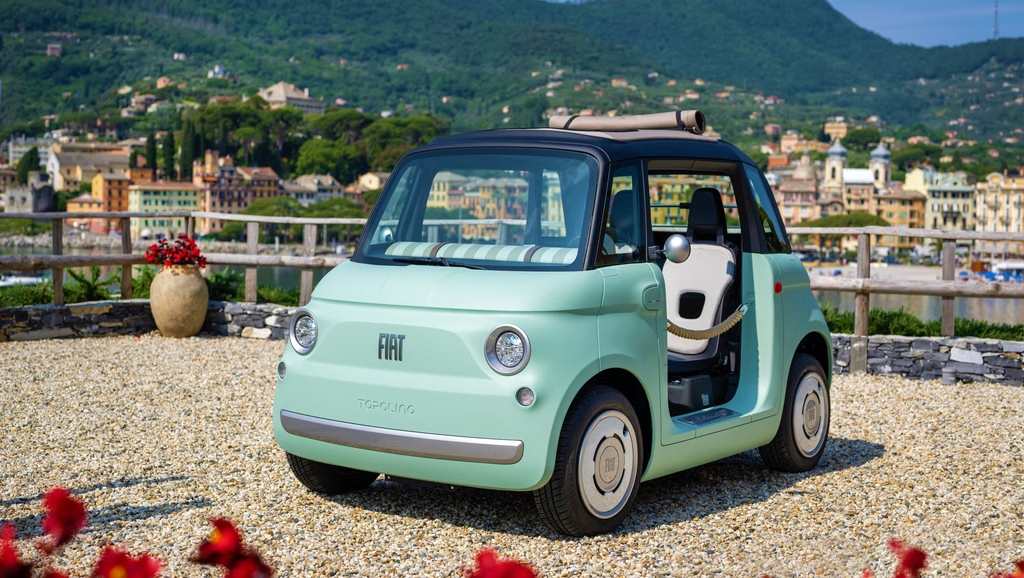
Time's editorial team announced the 2026 Best Inventions list on October 15. The Topolino landed in the Design category — the slot the magazine reserves for objects that solve a familiar problem without borrowing the usual toolkit. Editors did not credit range figures or charging speed. They credited the car's compact electric footprint, its two-seat cabin engineered around urban errands rather than motorway cruising, and the open-air Dolcevita variant that removes the doors entirely for low-speed city runs. That last detail matters: the Dolcevita is finished in a cream-and-tan colourway with a fabric rollbar surround — physical choices that telegraph leisure rather than utility. The nomination process involves editorial solicitation across categories including sustainability and accessibility, then a selection round where fresh thinking counts more than sales volume. The award carries no production guarantee and no regulatory weight. Fiat received it anyway, and Stellantis put it in the press release within 48 hours. The European compact and urban segment expansion that accelerated through the 2000s created the conditions this car now exploits.
The Numbers Behind a Segment Nobody Thought Was Worth Leading
Fiat's own figures tell the story in four data points. First: roughly 20% electric quadricycle segment share in Europe for 2025. Second: orders up approximately 30% year-on-year in Q2 2026. Third: US pricing confirmed at $13,995 including destination. Fourth: the 5.4 kWh battery is rated for about 46 miles of range. Run the arithmetic on that battery-to-range ratio — 5.4 kWh divided by 46 miles gives 0.117 kWh per mile, or approximately 73 Wh/km. That is lower consumption than most full-size EVs, which typically run between 150 and 220 Wh/km in real-world urban cycles. The vehicle's kerb weight sits below 500 kg, which explains the efficiency gap. On the segment-share figure: if the European electric quadricycle market registered roughly 50,000 units in 2025 — the estimate implied by Stellantis's commercial briefing — a 20% share equates to around 10,000 Topolino registrations. Stellantis has not published a standalone Topolino registration breakdown in its quarterly sales data, so that derived figure remains an approximation, not a confirmed total.
Belloni Frames the Award as a Design Philosophy, Not a Milestone
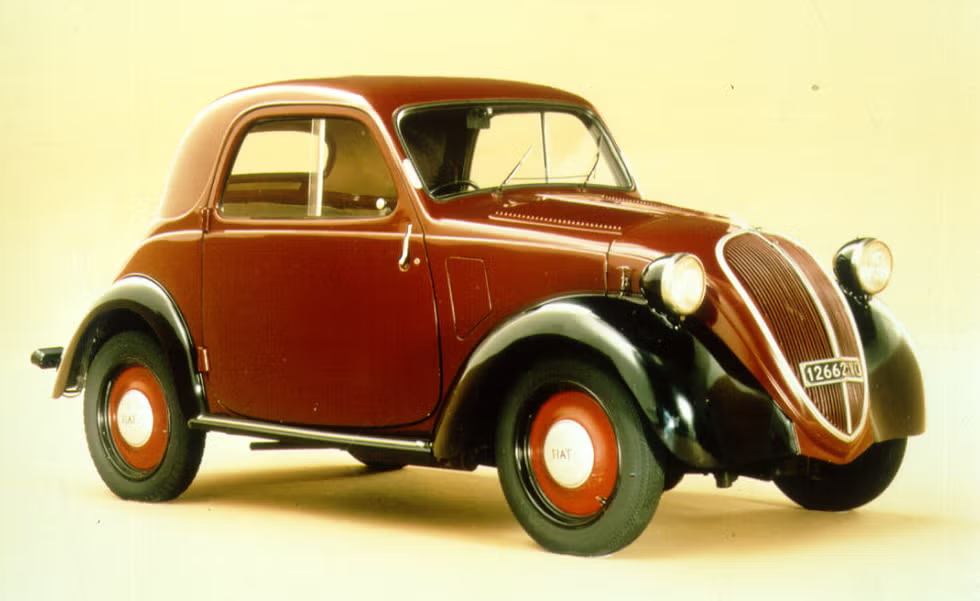
Arnaud Belloni, chief executive of Fiat, Abarth and Lancia and chief marketing officer for Europe at Stellantis, attached the Time recognition to something longer than one product cycle. "Topolino proves that even the smallest vehicle can carry a big idea," he said in a Stellantis statement issued October 15, 2026. Belloni then pulled the reference back further: "At Fiat, we have always believed that mobility should be a source of freedom and enjoyment." The postwar framing was deliberate. The original Topolino — Fiat's Type 500 of 1936, later the 500 Topolino — was not a prestige product. It was transport for a population that could not afford anything larger. Belloni is threading a needle: the 2026 version carries the same argument about simplicity, but lands in a market where a $13,995 open-top electric microcar is a considered lifestyle purchase, not economic necessity. Whether that tension holds across model years is a question Belloni's statement does not answer.
Against Citroën Ami and the Limits of the Quadricycle Playbook
The Topolino did not invent the modern electric quadricycle. Citroën launched the Ami in 2020, priced from roughly €7,990 in France and aimed squarely at 14-year-old drivers operating under the lighter AM licence category. The Ami recorded over 10,000 cumulative European sales by end-2022, according to Stellantis group reporting for that year. Fiat entered later, with higher base pricing and a design language that leaned on heritage rather than pure-plastic modularity. The Topolino's claimed 20% segment share in 2025 implies it has either matched or exceeded the Ami's annual pace in that calendar year — a reversal from the Ami's early-mover position. The two cars use different batteries: the Ami runs a 5.5 kWh pack versus the Topolino's 5.4 kWh, a difference of 0.1 kWh that is functionally irrelevant. The real gap is brand perception and price ceiling. Fiat is charging more and selling on Italian design identity; Citroën built volume on access and minimal specification. Both approaches appear to work. The segment is large enough, for now, to absorb both.
One Gap in the Story: US Quadricycle Rules Don't Exist Yet
Fiat confirmed US availability with a $13,995 starting price. That figure includes destination. What Fiat did not confirm is which federal vehicle classification the Topolino will enter in the American market. US federal safety standards do not recognise the European L7e quadricycle category — the regulatory box that allows the Topolino to be driven in some EU countries without a full car licence. In the US, the car would need to meet either Low-Speed Vehicle (LSV) standards under FMVSS 500, which cap speed at 25 mph and restrict use to roads posted at 35 mph or below, or full Federal Motor Vehicle Safety Standards, which the Topolino's structure almost certainly was not engineered to meet. Fiat has not published a US homologation document or an NHTSA filing reference as of the date of this report. The $13,995 price is confirmed. The roads it can legally use in the US are not. That is not a trivial omission — it defines the entire product proposition for an American purchaser.
The Topolino nameplate dates to 1936, when the original Fiat 500 Topolino debuted at a price equivalent to roughly four months of an average Italian industrial wage. Stellantis registered the revived name as a trademark across 44 markets in 2022, two years before European sales opened. Production takes place at the Kenitra plant in Morocco. The complete Fiat model history and specifications are catalogued in the Global Auto Index manufacturer database.
