Recovered lithium, nickel, cobalt and manganese will feed production battery cells from 2028, ahead of EU passport rules.
Porsche has built it. A battery cell. Cathode made entirely from recovered lithium, nickel, cobalt and manganese — no blended percentage, no mined top-up. The cells came off a pilot line run with Cologne-based recycler Cylib and are now in operational testing.
The timing is deliberate. The EU Battery Regulation's digital battery passport requirement lands on 18 February 2027, mandating electronic records across roughly 71 standardised data points for every EV battery above 2 kWh placed on the EU market, according to a Joint Research Centre assessment published September 2026. No comparable closed-loop cathode pilot has been publicly confirmed peers or , making Porsche's position on this timeline unusual.
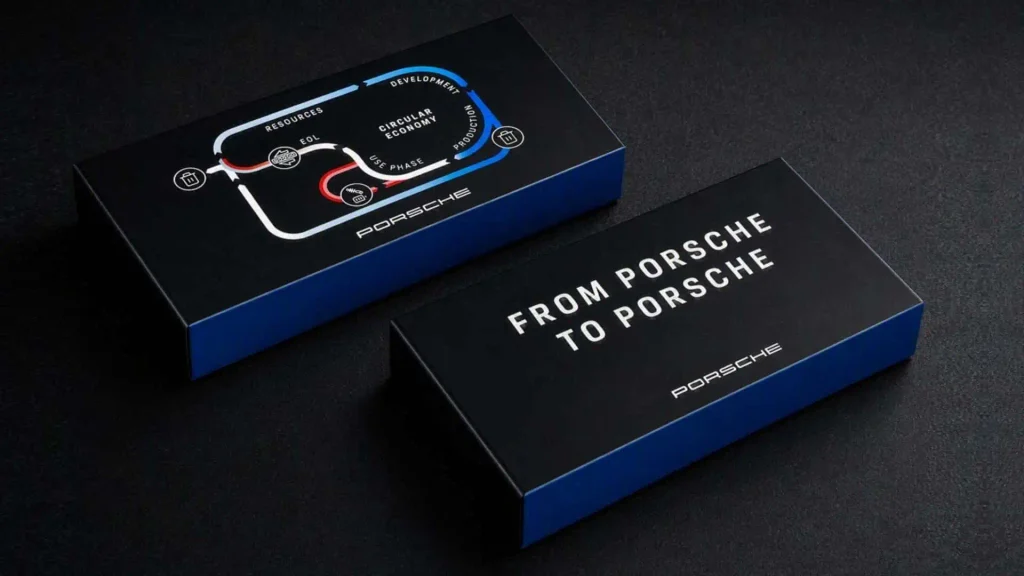
How End-of-Life Packs Became Cathode Feedstock
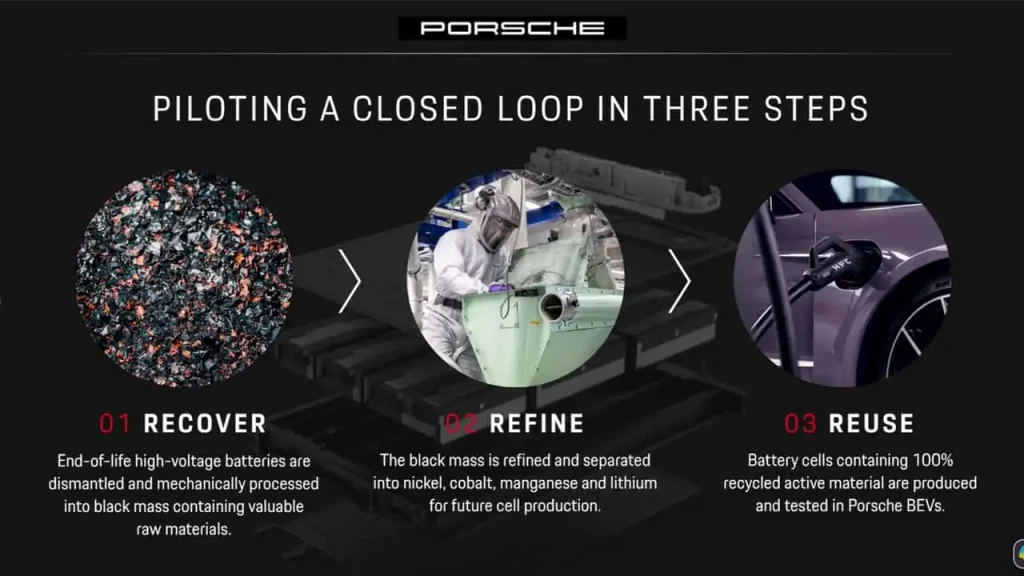
The pilot launched in 2025. By May 2026 it had moved off the lab bench and into operational flow: end-of-life high-voltage battery packs pulled from Porsche Centres across Germany began routing into Cylib's water-based hydrometallurgical process rather than going into storage or basic smelter recovery. Cylib shredded the packs, dissolved the black mass, and separated lithium, nickel, cobalt and manganese at purities sufficient for direct cathode re-synthesis. That last step is where most recycling chains stop short — material exits as a traded commodity rather than re-entering a manufacturer's own cell production. Here it went straight back. Porsche's internal tracking system, which the company calls a dedicated material account, logs each recovered metal separately so recycled content can be verified at cell level. The resulting cells are undergoing extensive operational testing as of the September 2026 announcement. This work sits within the broader BMW and Porsche performance EV transition reshaping how Stuttgart and Munich approach battery sourcing.
What the Two Executives Said — and What They Did Not
Joachim Scharnagl, Porsche's Executive Board member for procurement, framed the result in production terms: "with battery cells made entirely from recycled raw materials such as lithium and cobalt, we have achieved an important technological milestone." The statement covers what was done. It does not specify yield rates from the pilot line, cost per kilogram of recovered cathode active material relative to mined equivalents, or the number of cells produced. Cylib's co-CEO, Dr. Lilian Schwich, was more direct about the engineering difficulty: "Cylib closes the battery recycling loop, from end-of-life batteries to recovered raw materials." Getting metals clean enough to re-enter cathode synthesis — rather than being downgraded to lower-value uses — is the harder problem. Schwich's phrasing acknowledges that distinction without quantifying the purity thresholds Cylib achieved. Neither executive confirmed whether third-party cell manufacturers or Porsche's own cell development operation in Tübingen will produce the 2028 production volumes.
The Regulatory Numbers Driving the 2028 Target
Three numbers define the regulatory pressure. First: 2 kWh, the threshold above which every EV, light-transport and industrial battery placed on the EU market must carry a digital battery passport from 18 February 2027. Second: 71, the approximate count of standardised data points that passport must document — chemistry, lifecycle status, recycled content share. Third: 2028, the year Porsche says recovered raw materials will support new cell production, giving the automaker roughly twelve months of buffer between passport enforcement and its first recycled-content production cells reaching a vehicle. That twelve-month gap matters. If the EU's 2030 minimum recycled-content thresholds — cobalt 16%, lithium 6%, nickel 6% by regulation schedule — apply to cells entering service, a 2028 production start gives Porsche approximately 24 months of ramp time before those thresholds bite. Twenty-four months divided across validation, supplier qualification and yield improvement is not a comfortable margin. The EU Industrial Accelerator Act adds further urgency by tightening rules on battery supply chains accessing European manufacturing incentives.
The Gap Between the Claim and the Scale
Porsche produces roughly 320,000 vehicles a year. The Taycan family — Taycan, Taycan Cross Turismo, Taycan Sport Turismo — accounted for approximately 40,000 units in 2024, each carrying a battery pack between 79.2 kWh and 105 kWh gross. At the low end, 40,000 packs at 79.2 kWh each equals 3.168 million kWh of battery capacity annually. A pilot line that has demonstrably produced some number of cells with fully recycled cathodes says nothing about whether Cylib's water-based process can handle that throughput. Cylib has not published rated annual processing capacity. Porsche has not confirmed how many tonnes of black mass the May 2026 Germany-wide collection scheme has generated. The Joint Research Centre assessment published September 2026 noted that current EU recovery rate targets already balance industry flexibility against material recovery — which implies the targets were not set at the level of what is technically possible. Whether Cylib's process meets production-scale economics remains, as of the announcement date, an open question. The Kia UK's concern about ZEV mandate pacing reflects a parallel tension between regulatory ambition and physical supply chain capacity.
What This Means for Porsche's Supply Chain Position
If the process scales, Porsche gains a direct material loop that reduces exposure to lithium and cobalt spot markets, both of which moved sharply between 2022 and 2024. Cobalt in particular has a documented supply concentration risk: the Democratic Republic of Congo accounted for over 70% of mined cobalt output in 2023, according to the European Commission's Critical Raw Materials Act impact assessment. A verified recycled-content supply, trackable through the dedicated material account system, would also give Porsche a compliance asset under the incoming battery passport — it can document recycled share at cell level rather than estimating it from supplier declarations. For Porsche Centres across Germany, the operational change is already live: end-of-life packs no longer accumulate in workshop storage or route to generic smelter recovery. They move into a traceable stream. The test is whether that stream holds when volume increases from pilot quantities to the tens of thousands of packs Porsche will need to process annually as its Taycan fleet ages into the replacement window opening around 2027 to 2029.
Cylib was founded in Aachen in 2022 and has received funding under Germany's Federal Ministry of Education and Research battery research programme. The company's water-based process avoids the pyrometallurgical smelting route, which typically loses lithium entirely during processing. Porsche's first Taycan left the Zuffenhausen line in September 2019 — meaning early customer packs are now approaching their sixth year in service. The complete Porsche model history and specifications are catalogued in the Global Auto Index manufacturer database.
