The fuel cell truck targets 5,512 lb of towing — 1,100 lb more than the battery-electric Hilux can manage.
Toyota put a production date on its hydrogen Hilux at IAA Transportation 2026 in Hannover. The truck arrives in 2028. It targets 248 miles of WLTP range and 5,512 pounds of towing. Those numbers beat every specification the battery-electric Hilux currently publishes.
The announcement matters because no hydrogen fuel cell mid-size pickup is commercially available in Europe today. According to Toyota Europe's press briefing, published September 2026, corporate fleets and leasing companies are the confirmed first customers — not private buyers. Against the battery-electric Hilux's published 149–152 miles of WLTP range, the FCEV's 248-mile target represents a 63–66 percent range advantage on paper.
What Toyota Announced at Hannover
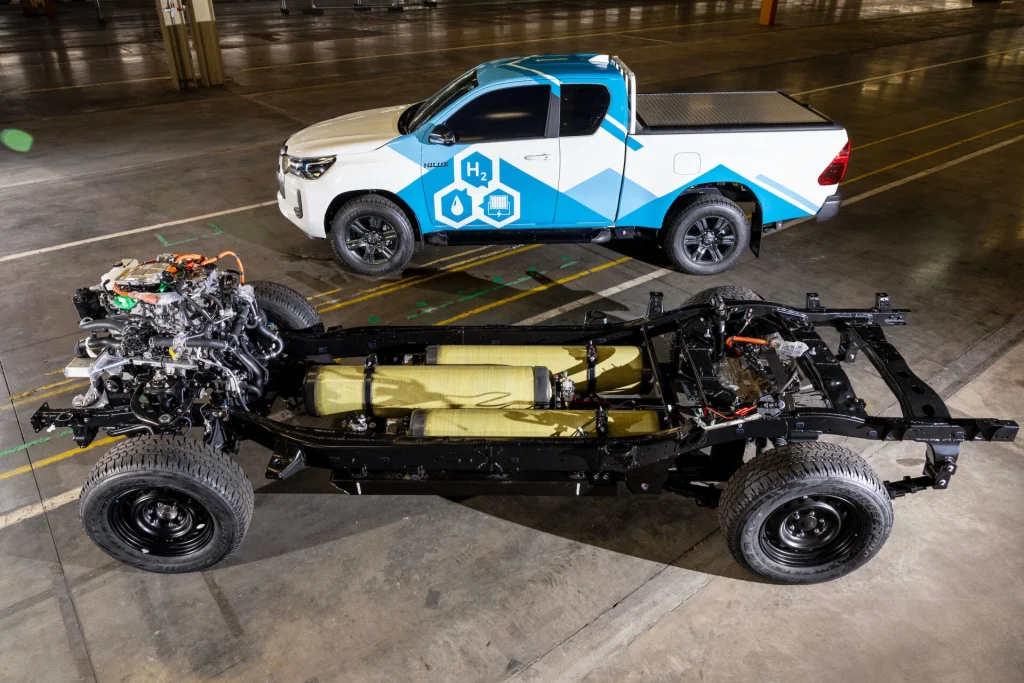
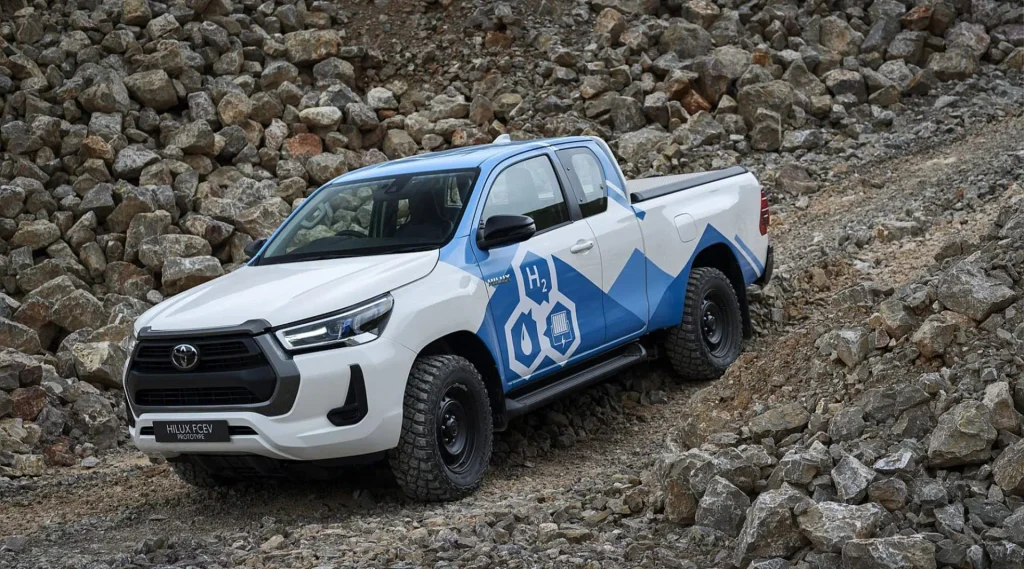
Toyota Europe took the IAA Transportation 2026 show floor in Hannover to lay out the timeline. The hydrogen Hilux enters production in 2028 on the ninth-generation platform already shared with diesel and petrol variants currently on sale. The fuel cell version joins the lineup — it replaces nothing. Toyota described the powertrain architecture as closely related to the Mirai sedan, its hydrogen passenger car, which has been on sale in Europe since 2021. The chemical process converts hydrogen and oxygen into electricity on board; water exits the tailpipe. No diesel particulate filter, no nitrogen oxide aftertreatment. Toyota confirmed the 2028 date and the 248-mile WLTP target during the show. Pricing was not disclosed. No North American launch date or timeline was mentioned, and Toyota gave no indication one is planned. For coverage of Toyota's broader product decisions across the past two decades, see the Toyota global product strategy tracker on this site.
Range, Towing, and Refuel Time: The Numbers Side by Side
The FCEV targets 248 miles of WLTP range against the battery-electric Hilux's published 149–152 miles — a midpoint gap of roughly 98 miles, or approximately 64 percent more range. Towing: the hydrogen truck targets 5,512 lb (2,500 kg); the electric Hilux is rated to 4,410 lb (2,000 kg). That is a 1,102 lb difference — 25 percent more towing capacity for the FCEV. Refuelling: Toyota cites approximately five minutes at a functioning hydrogen dispenser. DC fast charging for the electric Hilux from 10 to 80 percent takes around 30 minutes on a suitable high-power charger — six times longer. On a five-day working week, assuming one charge or refuel per day, the cumulative difference is roughly 125 minutes per week in downtime. For a contractor running three vehicles, that is over six hours weekly. The arithmetic favours hydrogen on uptime, not on infrastructure density.
200 Hydrogen Stations vs 1.3 Million EV Charge Points
The infrastructure gap is the number that overrides every performance specification. According to data compiled by the European Alternative Fuels Observatory, referenced in its April 2026 infrastructure report, approximately 200 publicly accessible hydrogen refuelling stations operate across Europe, including the United Kingdom. Public EV charge points in the European Union alone exceed 1.3 million, according to the ACEA Charging Infrastructure Report, March 2026. That is a ratio of roughly 6,500 EV charge points for every one hydrogen station. For comparison, when Toyota launched the Mirai in Europe in 2015, fewer than 20 public hydrogen stations existed on the continent — so the network has grown tenfold in a decade, but it remains orders of magnitude behind battery infrastructure. The gap matters specifically to the Hilux FCEV's stated customer base: a corporate fleet running utility vehicles across regional depots needs reliable access within operational range, not a single station in a capital city. Separately, tariff pressure on commercial vehicles in both the US and EU may affect how quickly European fleet operators commit to any new-fuel truck programme.
The Infrastructure Commitment That Has Not Been Made
Toyota confirmed the vehicle. It has not confirmed station partnerships. That is the gap no specification sheet closes. Stellantis and Hyundai both announced hydrogen commercial vehicle programmes in 2021 and 2022 respectively, and both cited fleet operator partnerships at launch — named companies, named routes, named depot locations. Toyota's Hannover announcement named none of those. No leasing partner was identified by name. No depot-to-depot route was described. No infrastructure co-investment agreement with a fuel supplier — Air Liquide, Linde, or any other named operator — was referenced in the Toyota Europe briefing. Florian Huettl, Chief Executive Officer of Toyota Motor Europe, addressed media at the show but did not name a launch fleet customer, according to reporting from the IAA Transportation press pool. The Hilux FCEV's WLTP range of 248 miles becomes a depot-to-depot proposition only if a hydrogen dispenser exists at each end. Right now, in most of Europe, it does not. Kia's experience in the UK — 100,000 EVs sold but its own executives calling ZEV mandate timelines unrealistic — shows how quickly infrastructure shortfalls can complicate fleet adoption projections.
What the 2028 Date Means for European Fleet Procurement
A 2028 production start drops the Hilux FCEV into a specific regulatory window. The European Commission's revised CO₂ standards for light commercial vehicles, confirmed under Regulation EU 2019/631 as amended, require a 50 percent reduction in fleet average CO₂ by 2030 against the 2021 baseline. For a fleet operator procuring work trucks in 2027 or 2028 — typically on four-year replacement cycles — a zero-emission hydrogen option arriving in that window lands at exactly the right procurement moment. DHL Supply Chain, which operates one of Europe's largest light commercial vehicle fleets, has publicly committed to zero-emission last-mile delivery in twelve European cities by 2030, according to its 2025 Sustainability Report. A hydrogen Hilux with 248 miles of WLTP range and five-minute refuelling fits that brief operationally — provided DHL can access hydrogen at its sorting depots. That access does not currently exist at most DHL facilities. The regulatory deadline is fixed. The infrastructure timeline is not. That mismatch will decide whether the Hilux FCEV becomes a volume fleet product or a compliance statement. The EU Industrial Accelerator Act may accelerate hydrogen infrastructure investment, but its hydrogen provisions remain in draft as of publication date.
Toyota's hydrogen Hilux programme sits alongside the Hilux Dakar 2027 campaign — a separate hydrogen combustion entry, not a fuel cell vehicle — which Toyota confirmed will run on compressed hydrogen burned directly in a modified engine. The two programmes share a platform, not a powertrain. Production of the ninth-generation Hilux began at Toyota's Durban, South Africa facility in 2023. The complete Toyota model history and specifications are catalogued in the Global Auto Index manufacturer database.
