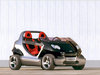
Intro: Originally, the same team that owns the Swatch watch empire in Switzerland devised the Smart concept. The company needed an engine to power its innovative city car, which would be rear-engined, but would only feature two seats and a small load platform. Mercedes-Benz would be the supplier. So, the company was already intrigued by the concept, but, at that time, it did not wish to participate with any commitment. Sadly, the project swallowed an enormous amount of the set-up capital and, following a protracted series of meetings, Daimler-Benz was drawn in to secure the project’s future. To begin with, Smart cars would be sold through company owned sites based in city centres around Germany. The sites would be easy to recognise because of the well-lit glass towers that would house ’dealer stock’.
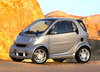
The innovative two-seater uses a ’Tridion’ safety cage, onto which easily replaceable plastic panels are attached. The 599cc three-cylinder engine requires only limited maintenance and is hidden from sight beneath the rear floor. It develops a busy 44-61bhp in standard form, although some tuning companies (including Mercedes-Benz’s own AMG) have managed to generate over 80bhp. In essence, the Smart project is probably one of the greatest marketing exercises that the European motor industry has ever witnessed. A complete range of lifestyle enhancing accessories has been developed alongside the vehicle and every element of the car is quite simply ’smart’.
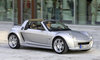
From 2003 the line-up includes the new roadster and roadster-coup’.
In 2002 the Hambach plant has been expanded to include a further production line for future products.
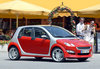
The first four-door Smart, called Forfour was introduced in 2003. In 2004 the original Smart models were renamed to Fortwo.
Smart has now been fully integrated into the DaimlerChrysler network. As it keeps making losses year-by-year a restructuring program is under way. |