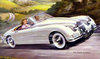
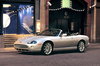
Intro: The first Jaguar car did not appear until 1945, but Sir William Lyons had been producing motorcycle sidecars in Blackpool, Lancashire, for the previous 23 years. At that time, the company was known as Swallow Sidecars, which was soon corrupted to SS for the first SS100 model launched by the company in 1931. However, the use of SS as a model name was not so popular immediately after the Second World War and soon Lyons dropped the initials and concentrated on Jaguar instead.
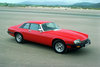
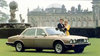
He continued as the founder and chairman of the company until he retired in 1972. On the way, Sir Bill had pursued a series of victories at the annual Le Mans 24-Hours Race (five times in seven years) in the late-1950s, with his team manager, ’Lofty’ England. In fact, so successful was the company that it absorbed Daimler in 1960 and Coventry-Climax in 1963. The company was remarkably small, but managed to give an international impression of great stature. Its famous Mark Two spawned the S-type and then the 420, which later became the replacement for the Mark Ten in stretched form. Of course, in the middle of that was the glorious late-1950s and the arrival of the E-type, which gave wind-in-the-hair motoring a fresh spin. Lyons sold out to BMC in 1966, which meant that in 1968 the entire company became part of the British Leyland set-up.
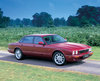
Unfortunately, Jaguar Cars then became part of the state-owned firm in 1975, which was an all-time low for the firm. Sir John Egan arrived with the company in the early-1980s and things started to look up. By 1984, the company was ’privatised’ again. However, its independence was short-lived, because the development of new models had wiped out the company’s resources. Ford Motor Company acquired Jaguar in 1989 and the V8 engined cars were introduced. Since that time, the company has become a part of the Premier Automotive Group, which encompasses the prestige brands within Ford’s portfolio of manufacturers. 100,770 models sold globally in 2001. |