VW's supervisory board has yet to approve the investment, leaving every construction milestone provisional.
Four billion dollars. That is what Audi has reportedly tabled for a factory in Peach County, Georgia — and the plant is doing double work before a single vehicle rolls off it. The tariff angle came first, according to a Reuters report published in late 2024. Construction has not started.
The arrangement matters now because Audi's Q7 and Q8 — assembled in Bratislava, Slovakia — face a 15 percent US import tariff under Trump-era EU auto levies, according to Reuters reporting cited discussions. That rate could fall to somewhere between 7.5 and 10 percent if Audi commits capital to American soil. Compare that to 2018, when the US tariff on EU passenger vehicles sat at 2.5 percent — the gap since has reshaped every European brand's export arithmetic.

How the Tariff Relief Arrangement Took Shape
The Trump administration opened a channel for automakers willing to pledge US manufacturing investment. Audi walked through it. The brand formally tied its Fort Valley project to a request for reduced duties on imports that would keep arriving from Europe while the Georgia site was being built. Reuters reported the outline of these talks, describing a Commerce Department framework — not yet finalised — that would reward capital commitment with temporary tariff concessions. Audi asked for a cut from 15 percent to 7.5 percent. Commerce officials floated 10 percent as a counterpoint. Neither figure has been made official. The negotiation sits inside a broader discussion around EU trade barriers and US automotive regulation that has accelerated since the 25 percent tariff on European cars took effect. For Audi, the window of relief would cover the years between now and early-2030s production, when Georgia cannot yet offset what Bratislava ships westward.
The Numbers Behind Fort Valley
The site is 1,500 acres at the Middle Georgia Megasite, Fort Valley, Peach County. Audi projects 4,500 direct jobs and a production ceiling of 200,000 vehicles per year once the plant reaches full output, targeted around 2031. Grading is pencilled in for 2027; construction proper for 2028; first vehicles in the early 2030s — call it a six-year runway from now to volume. On tariffs: at 15 percent applied to, say, 30,000 Q7 and Q8 units annually at an average US transaction price of roughly $90,000, the annual duty bill runs to approximately $405 million. At 10 percent the figure drops to $270 million — a saving of $135 million per year during the ramp-up period. At the requested 7.5 percent it falls further to $202.5 million, a $202.5 million annual reduction against the current rate. Arithmetic: $90,000 × 30,000 = $2.7 billion in import value; 15% × $2.7 bn = $405 million; 10% × $2.7 bn = $270 million; difference = $135 million. Over five pre-production years, that gap compounds to $675 million — not an immaterial consideration against a $4 billion capital pledge.
Porsche Says No, Audi Says Yes — Same Parent Company
Porsche AG, which shares Volkswagen Group ownership with Audi, has publicly declined to establish US vehicle assembly operations. The contrast is direct: two brands under the same Wolfsburg roof are running opposite calculations on the same tariff environment. Porsche's rationale, as stated to press in 2024, centred on volume — its global output sits below 400,000 units annually, making dedicated US tooling harder to justify. Audi's target of 200,000 units from Georgia alone implies a different scale assumption. In 2023, Audi delivered approximately 175,000 vehicles in the United States, according to Volkswagen Group's annual delivery report for fiscal year 2023. A 200,000-unit Georgian plant would therefore theoretically cover more than the entire current US retail volume, suggesting export capacity is built into the design from day one. Porsche delivered roughly 70,000 units in the US during the same period — less than half the Georgian plant's stated ceiling, which partly explains the divergent answers to the same policy question.
The Board Vote That Has Not Happened
Here is what has not been confirmed: Volkswagen AG's 20-member supervisory board has not voted to approve the $4 billion Georgia commitment. That vote has not been scheduled publicly as of the time of reporting. Every number attached to Fort Valley — the acreage, the job count, the production capacity, the tariff negotiation — rests on a reported plan rather than a ratified investment decision. The anomaly is that tariff discussions between Audi and US Commerce Department officials appear to be progressing on the basis of a project that its own parent company has not formally authorised. Thomas Schäfer, Volkswagen Group CEO, has spoken publicly about restructuring pressures across the German manufacturing base, including at the Neckarsulm plant where Audi builds the A6, A7, and A8 ranges. Whether the board's reluctance reflects broader VW Group capital caution or simply procedural timing has not been answered in any official communication reviewed for this article. The gap between negotiation and ratification is not small: $4 billion uncommitted is $4 billion that could move.
What a Lower Tariff Rate Means for Bratislava's Production Line
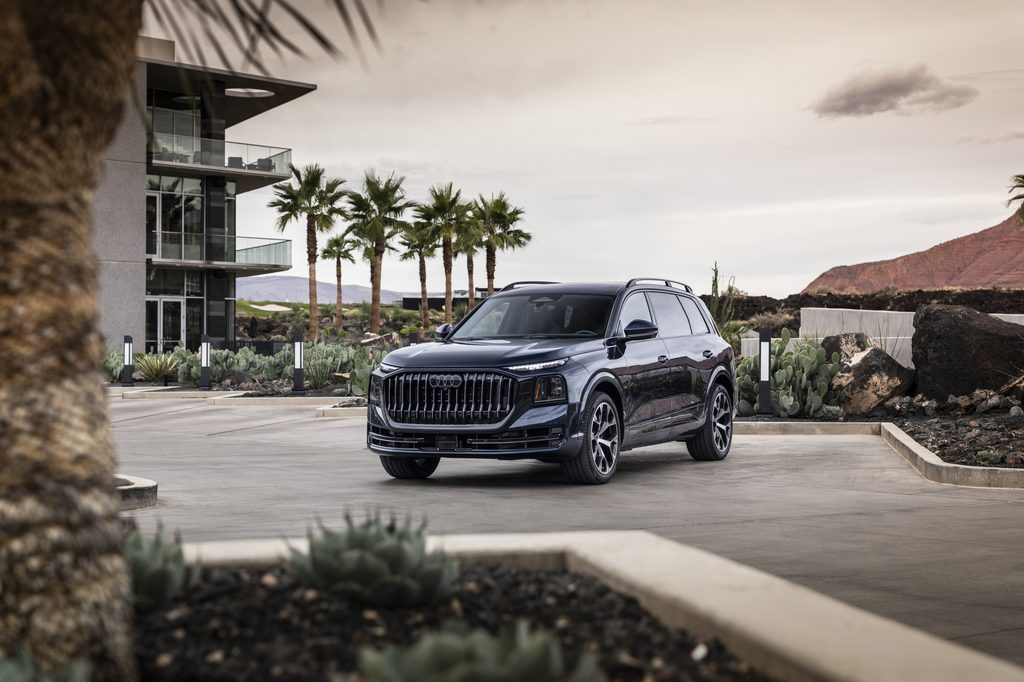
If the Commerce Department confirms even the 10 percent rate, the immediate beneficiary is the Bratislava assembly plant in Slovakia, which builds the Q7 and Q8 for global markets including North America. A lower US tariff extends the commercial life of that production arrangement — Audi can keep shipping Bratislava-built vehicles profitably for longer, reducing pressure to accelerate Georgian construction timelines or front-load US localisation. For the Q7 specifically, which entered its current generation in 2020 and faces a mid-cycle refresh cycle before any Georgia-built successor arrives, Bratislava's output stays commercially viable under a 7.5–10 percent regime in ways it does not under 15 percent. The consequence for American consumers is less direct: tariff savings do not automatically translate to lower sticker prices in a segment where Audi's Q7 lists from $62,400. What changes is Audi's margin on those transactions — and therefore its incentive budget and fleet pricing flexibility for the transition years.
Audi's parallel US production thread — a Scout-derived SUV model linked to Scout Motors' South Carolina plant in Blythewood, scheduled to open in 2026 — was not part of the Georgia tariff discussions as reported. That facility represents a separate VW Group investment of approximately $2 billion. Two plants. One board. No final approval yet on either Georgia commitment. The complete Audi model history and specifications are catalogued in the Global Auto Index manufacturer database.
